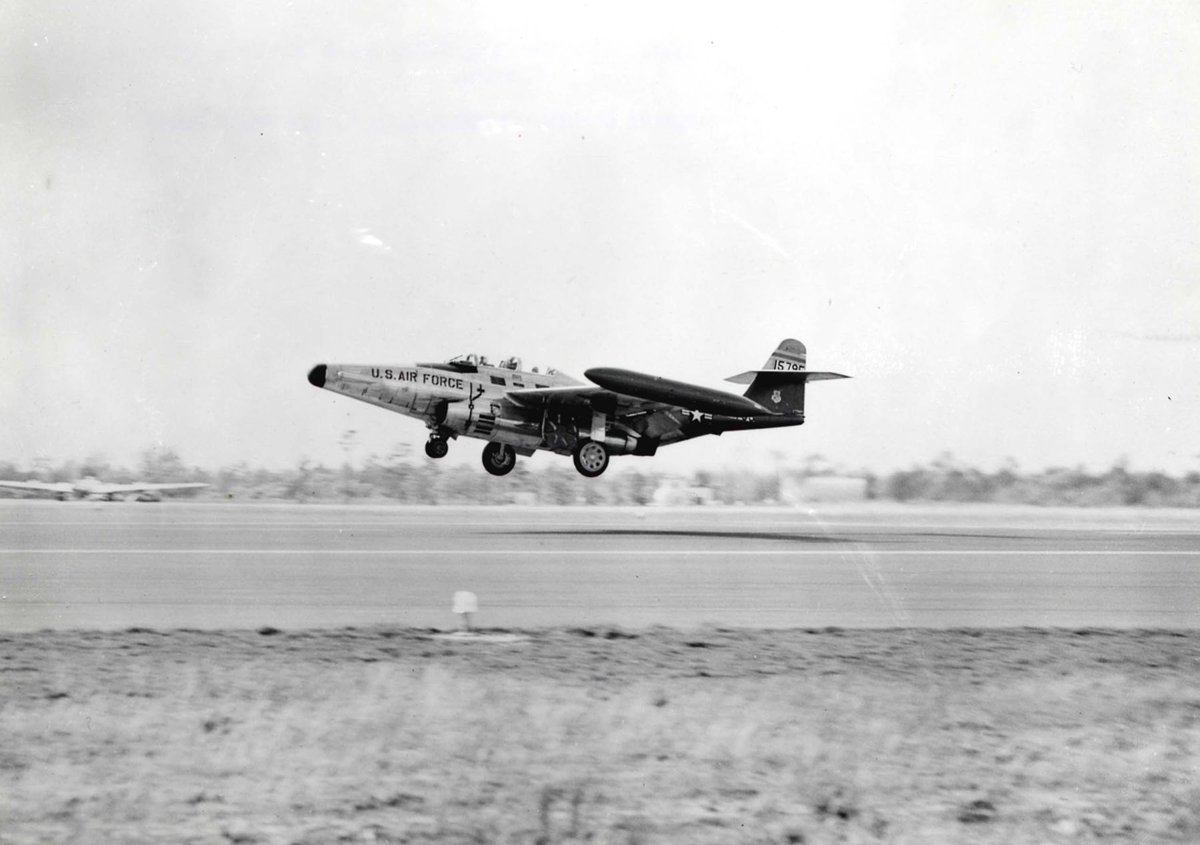
Two Blips Became One: The F-89 That Vanished Over Lake Superior, and What the Air Force File Actually Says
ARCHIVE FILE · Event year: 1953. This happened in 1953 and is not breaking news. It’s part of the Redacted Weekly evergreen archive, published a week before the incident’s 73rd anniversary.
CASE FILE: RW-DAILY-2026-1116-PM
Subject: Disappearance of F-89C Scorpion 51-5853A and its crew during an air-defense intercept over Lake Superior
Key dates: Scramble and loss 23 November 1953 · search 24-28 November 1953 · aircraft “not located as of 1 January 1954” · RCAF letter 14 April 1961 · USAF releases the accident file under FOIA, 1990s · dive-company wreck claim September 2006
Location: Northern Lake Superior, scrambled from Kinross Air Force Base, Michigan; tracked by ground radar sites in Michigan’s Upper Peninsula
Status: Jet and crew lost CONFIRMED · radar returns merged CONFIRMED (USAF file) · target was RCAF C-47 VC-912 UNVERIFIED · collision with a UFO UNVERIFIED · 2006 wreck discovery DEBUNKED · leading mundane: a crash into the lake at night in snow and icing conditions, cause unknown
What happened
At 6:22 p.m. Eastern Standard Time on Monday, 23 November 1953, an F-89C Scorpion all-weather interceptor took off from Kinross Air Force Base, south of Sault Ste. Marie, Michigan. Aboard were 1st Lt. Felix Eugene Moncla Jr., the pilot, and 2nd Lt. Robert Wilson, the radar observer, both of the 433rd Fighter-Interceptor Squadron from Truax Field in Madison, Wisconsin. They were filling in at Kinross while the base’s own squadron was away at gunnery training in Arizona.
Their job was to identify an unknown aircraft over Lake Superior. According to the Air Force’s Report of Aircraft Accident, ground radar directed the jet north, brought it down from 30,000 feet to 7,000 feet, and at 6:51 p.m. told the crew the target was “at 11 o’clock, 10 miles distant.” Then, in the report’s words: “Radar returns from both aircraft were then seen to merge on Pillow’s radar scope. The radar return from the other aircraft indicated it was continuing on its original flight path, while the return from the F-89 disappeared.”
No wreckage, oil slick or body was ever found. The Air Force later said the “unknown” was a Royal Canadian Air Force transport. The RCAF said it had no record of any incident. That gap has kept the case alive for more than seven decades.
The video evidence first
There is no footage from 1953. The two videos below are a local TV news report from the radar site and a sourced explainer. Descriptions come from each video’s title, description and chapter list, plus TV6’s accompanying article.
1. “70 years later: researchers talk Kinross Incident research, progress of Open Skies Project,” Upper Michigan’s Source | TV6 & FOX UP (WLUC)
- Uploaded: 23 November 2023 · Length: 2:33 · Reporter: Colin Jackson
- What it covers (per TV6’s article of 22 November 2023): filmed at the former Calumet Air Force Station in Keweenaw County, the radar site whose call sign was “Pillow.” Kyle Kary, president of the Calumet Air Force Station Heritage Museum, recounts that “there was an unidentified aircraft detected off of Lake Superior at the radar station here.” TV6 reports that the two returns “converged” about 77 miles north of the station. Kary says rumors and conflicting accounts have “muddied the facts” and calls the group’s compiled report unfinished.
2. “Kinross 1953: the interception where the two radar blips became one,” The Mad Pilot
- Uploaded: 12 September 2026 · Length: 8:16
- Key timestamps (per the creator’s chapter list): 0:48, the scramble; 1:40, the intercept; 2:35, what the radar operators reported; 3:13, the Air Force’s first answer; 3:48, “Canada says no”; 5:27, the 2006 wreck claim (“the part that is not true”); 6:07, what is actually unresolved. The description cites the RCAF letter of 14 April 1961.
Timeline
- Mid-October 1953: Kinross’s resident 438th Fighter Squadron leaves for gunnery training, and crews from Truax Field cover the base, according to the Open Skies Project history and the accident report.
- 23 November 1953, 6:22 p.m. EST: F-89C 51-5853A takes off from Kinross on an “Active Air Defense Mission,” under the control of the Sault Ste. Marie radar site, call sign “Naples.”
- 6:41 p.m.: Control passes to the Keweenaw (Calumet) radar site, call sign “Pillow.” The jet is at 30,000 feet.
- 6:47 p.m.: Pillow asks the jet to descend to 7,000 feet to begin the intercept, about 150 miles from Kinross over northern Lake Superior.
- 6:51 p.m.: The crew turns to a heading of 20 degrees and is told the target is 10 miles away. The returns merge; the F-89’s return disappears.
- 24-28 November 1953: USAF, U.S. Coast Guard, RCAF and Civil Air Patrol aircraft, plus the Coast Guard cutter Woodrush, search 29,600 square miles, according to the search appendix in the accident file. Heavy snow hampers the land search.
- 1 January 1954: The accident summary records that the aircraft and crew “had not been located.”
- 1955: Writer Donald Keyhoe publishes an Air Force public-information officer’s answer that “the unknown in that case was a Canadian DC-3,” as summarized in Moncla’s Wikipedia biography.
- 14 April 1961: The RCAF replies to a researcher’s letter: “A check of Royal Canadian Air Force records has revealed no report of an incident involving an RCAF aircraft in the Lake Superior area on the above date,” per the copy published by NICAP.
- 29-31 October 1968: Prospectors find aircraft parts near Cozens Cove and Alona Bay on Lake Superior’s east shore. A USAF officer identifies a stabilizer as from a military jet, but the Sault Star reports a link to the F-89 “later appeared unlikely,” according to researcher UFO*BC’s review of the Sault Star microfilm.
- 27 December 1993: A researcher files a Freedom of Information Act request. In reply, the Air Force Safety Agency releases the “releasable portions” of the accident report and withholds the board’s analysis, findings and witness testimony.
- September 2006: A “Great Lakes Dive Company” claims to have found the F-89 on the lake bottom. It turns out to be a hoax.
- 22 November 2023: TV6 reports from the former radar site on the 70th anniversary.
What believers claim
The UFO reading of the case goes like this. Trained radar operators watched two returns become one. If the target were a friendly transport, the F-89 would have passed above or below it and reappeared as a second blip. Instead it vanished, while the other return kept going. Canada said its air force had no record of an incident. And the Air Force’s explanation shifted over the years: a “Canadian DC-3” in 1955, an RCAF C-47 on a Winnipeg-Sudbury flight plan in the accident file. To many researchers, that adds up to a collision with, or capture by, something that was never identified. Some retellings go further and say the surviving blip shot off the screen at high speed.
What the research found
The Air Force’s own file confirms the core of the story. The accident summary, released under FOIA, states that the two returns merged on Pillow’s scope and that only the F-89’s return disappeared. It does not describe the jet as passing the target or turning away first. The form lists the aircraft and both crewmen as “Missing” and enters the place and hour of the accident as “Unknown.” That differs from an Air Force information sheet quoted by NICAP, which said the F-89 identified the friendly plane and then turned back toward base. The released accident summary says nothing about a turn back.
Log in to view the rest of this file
The rest of this file is open to any agent: free accounts get full access.
Log InCreate a free account