The ‘GoFast’ Video: A Speeding Object Over the Ocean? (2015)
ARCHIVE FILE · Event year: 2015. This happened in 2015 and is not breaking news. It’s part of the Redacted Weekly evergreen archive.
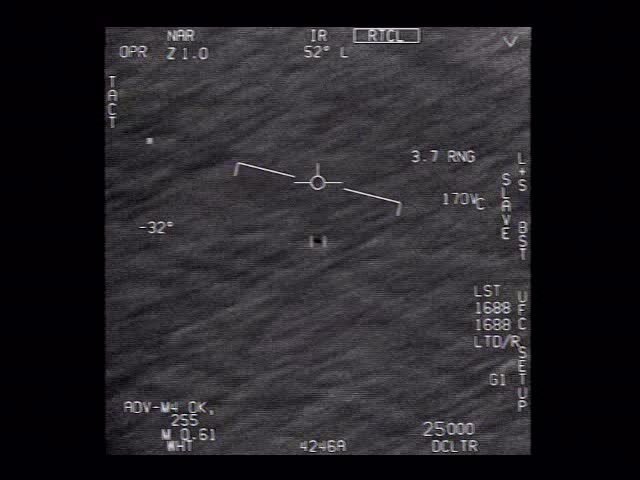
GoFast is the third of the Pentagon’s official UAP videos. It looks the most dramatic. A Navy fighter’s infrared pod locks onto a small pale object that seems to streak low over the Atlantic, and someone on the audio laughs as the lock holds. The on-screen numbers, though, give a much less dramatic picture.
CASE FILE · RW-ARC-UAP-003
Subject: Small object apparently moving fast over water
When: 21 January 2015 (date per the U.S. Navy)
Where: Atlantic training ranges off the U.S. East Coast
Platform: F/A-18F, ATFLIR pod; USS Theodore Roosevelt strike group
Evidence: About 34 s of infrared video with on-screen telemetry
Official status: “Unidentified” (DoD, 2020)
Actual speed: Considerably less “go” than advertised
The record
- 9 Mar 2018: To The Stars Academy released GoFast on YouTube, a few months after FLIR1 and GIMBAL appeared in The New York Times.
- Sept 2019: The Pentagon confirmed it was Navy footage. The Navy gave the date as 21 Jan 2015, the same day as GIMBAL, according to The Black Vault.
- 27 Apr 2020: The DoD formally released the video, now hosted by NAVAIR’s FOIA library.
The footage
From frames sampled every 3 seconds from the NAVAIR file:
- The background is sea surface texture for the whole clip, at a steep downward camera angle.
- 0:00–0:12: The pod hunts, with a tracking box visible and the target hard to pick out.
- ~0:15 onward: The pod locks. A small pale object sits in the reticle, and the range readout drops from about 4.4 to 3.4 (nautical miles) over the sampled frames.
- The altitude field reads about 25,000 ft for the jet.
Embed: official TTSA upload (uploaded 9 Mar 2018, 2:04): https://www.youtube.com/watch?v=wxVRg7LLaQA. The public-domain NAVAIR copy is hosted below.
How the video reached the public
The three Navy videos came out over several years, and accounts of the order differ a little:
- 16 December 2017: The New York Times published FLIR1 and GIMBAL. According to Wikipedia’s summary, the Washington Post also published a similar video called GOFAST around then, which differs from the 2018 date in our timeline above. We list both, and the TTSA upload date is the one we can verify.
- The clips were first given to the press by Christopher Mellon, a former Deputy Assistant Secretary of Defense for Intelligence. That was around the time Luis Elizondo resigned from the Pentagon in October 2017. Elizondo has described himself as director of the Advanced Aerospace Threat Identification Program (AATIP).
- September 2019: Pentagon spokeswoman Susan Gough confirmed the videos were made by naval aviators and called them “part of a larger issue of an increased number of training range incursions by unidentified aerial phenomena.”
The GIMBAL and GOFAST encounters involved pilots from the USS Theodore Roosevelt carrier strike group, who were training off the U.S. East Coast in 2014–2015. The pilots reported instrument detections of objects they couldn’t identify.
NASA ran the numbers
NASA’s 2023 independent UAP study panel (see our official-files post) used GoFast as its worked example. Its report says the video “gives an impression of an object skimming above the ocean at a great velocity. But analysis of the numerical information on the display reveals a less extraordinary interpretation.”
Using the camera’s elevation angle, the target range and the jet’s altitude, NASA calculated that:
- The object was at about 13,000 feet, and 4.2 miles from the ocean surface behind it in the camera’s line of sight.
- The jet’s groundspeed was about 435 mph. NASA says this means “the impression of rapid motion is at least partly due to the high velocity of the sensor, coupled with the parallax effect.”
- Over a 22-second window, during which the jet was banking left at about 15°, the object moved about 390 meters. That’s an average of roughly 40 mph, which NASA calls “a typical wind speed at 13,000 feet.”
- The object looks bright against a dark ocean in this display mode, so it’s colder than the ocean. NASA says there’s “no evidence of heat produced by a propulsion system.”
NASA added caveats. The calculation ignores wind effects on the jet, and more data would be needed to say what the object actually was. Its conclusion was that the object “is most likely drifting with the wind.”
What this does and doesn’t settle
The NASA analysis settles the speed and altitude question: GoFast doesn’t show a craft skimming the waves. It doesn’t identify the object. A balloon is the most common suggestion, and it fits a cold, slow, wind-drifting target, but nobody has matched a specific balloon to this flight. That’s why the “known, identified thing” row above stays UNVERIFIED.
As of 2020 the DoD still listed the objects as “unidentified,” which means not identified, not anomalous.
Grades
| Claim | Grade | Source |
|---|---|---|
| GoFast is genuine U.S. Navy footage | CONFIRMED | DoD, 27 Apr 2020; NAVAIR FOIA |
| Recorded 21 Jan 2015 | CONFIRMED | Navy statement via The Black Vault |
| The object was skimming the water at high speed | DEBUNKED (per on-screen geometry) | Analyses by Mick West and others using the displayed range and angle |
| The object is a known, identified thing | UNVERIFIED | DoD still lists it as “unidentified” |
| The object was at about 13,000 ft moving about 40 mph | CREDIBLE (NASA calculation, with stated uncertainty) | NASA UAP Independent Study report (2023), p. 27 |
| The object showed a heat signature from propulsion | DEBUNKED (it appears colder than the ocean) | NASA UAP report (2023) |
Log in to view the rest of this file
The rest of this file is open to any agent: free accounts get full access.
Log InCreate a free account