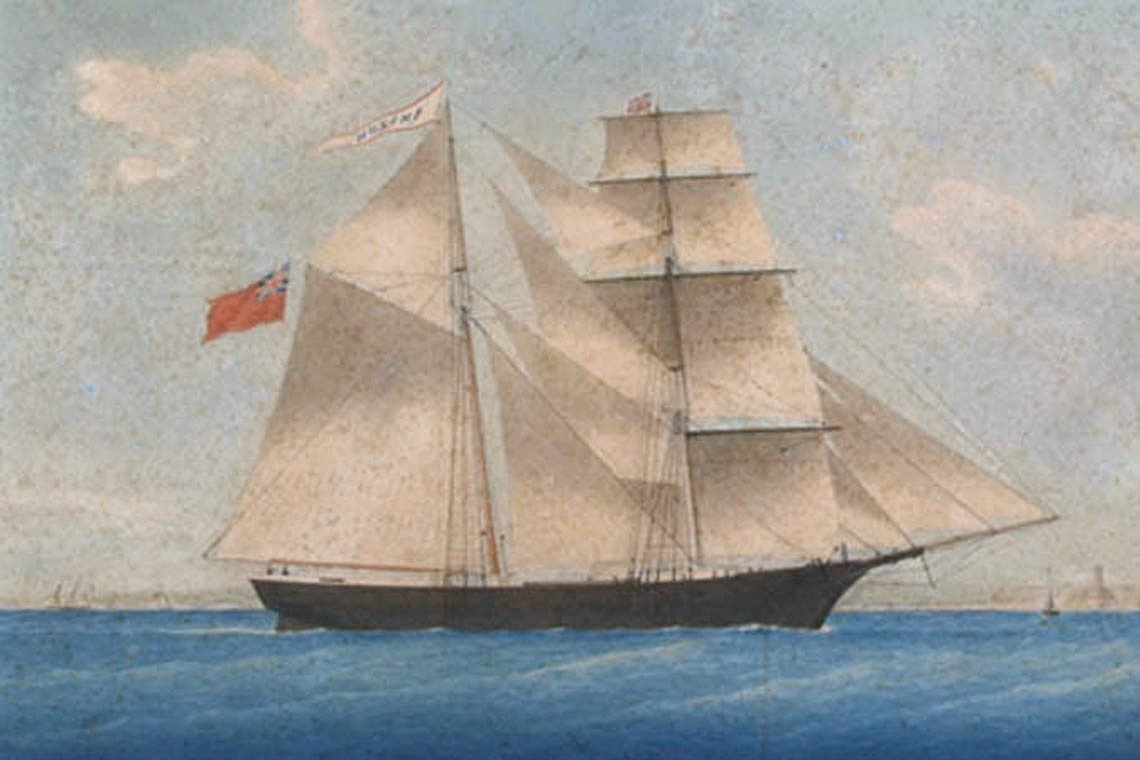
The Mary Celeste: The Ghost Ship Found Sailing Empty (1872)
Subject: Merchant brigantine found deserted at sea
Event: Found 4 December 1872; last log entry 25 November 1872
First report: Dei Gratia crew, December 1872 · Last checked: 4 Nov 2026
Location: Atlantic Ocean, about 38°20′N 17°15′W, between the Azores and Portugal
Status · Grade: Unsolved · Abandonment CREDIBLE
ARCHIVE FILE · Event year: 1872. This happened in 1872 and is not breaking news. It is part of the Redacted Weekly evergreen archive.
What happened
On 4 December 1872, the Canadian brigantine Dei Gratia came across another ship drifting in the Atlantic midway between the Azores and the coast of Portugal. It was the Mary Celeste, under partial sail, disheveled but seaworthy, still well supplied, with its cargo intact. Nobody was aboard. Captain Benjamin Spooner Briggs, his wife, their two-year-old daughter and seven crew had disappeared. None of them was ever found.
The ship had been launched as the Amazon at Spencers Island, Nova Scotia, on 18 May 1861, according to Wikipedia’s detailed history. It changed hands and names several times before a New York consortium headed by James H. Winchester refitted and enlarged it early in 1872. Briggs held four of its 12 shares.
The footage
There is no film of the 1872 events. The clip below is a modern documentary excerpt.
- “The True Story of the Mary Celeste”, uploaded to YouTube by the Smithsonian Channel on 7 August 2013; 1 min 59 s. The video’s own chapter list runs: “The Atlantic storm,” “Discovery of the ship,” “Missing crew and clues,” “The enduring mystery,” “Unthinkable actions,” “New evidence discovered.”
- Wikipedia notes that the Smithsonian Channel screened a documentary with the same title in November 2007. That film investigated many aspects of the case without settling on a solution, and its makers suggested a faulty chronometer may have led Briggs to think he was close to Santa Maria Island when he was about 120 miles farther west.
Timeline
- 18 May 1861: Launched as the Amazon at Spencers Island, Nova Scotia.
- October 1869: Seized by creditors and later sold to a New York consortium.
- Early 1872: A major refit costing $10,000 enlarges the ship.
- 20 October 1872: Briggs arrives at Pier 50 on the East River to supervise loading of 1,701 barrels of alcohol bound for Genoa.
- 3 November 1872: Briggs writes to his mother.
- 5 November 1872: The ship leaves Pier 50 and anchors off Staten Island to wait for better weather.
- 7 November 1872: It puts to sea.
- 15 November 1872: Dei Gratia leaves New York for Gibraltar on a similar route.
- 25 November 1872, 8 am: Last log entry, off Santa Maria Island in the Azores.
- 4 December 1872: Dei Gratia finds the ship deserted, nearly 400 nautical miles from the last logged position.
- 13 December 1872: U.S. Consul Sprague in Gibraltar writes to the State Department about the case (letter No. 123, per the authorities listed by the Mary Celeste research site maryceleste.net).
- 17 December 1872: Salvage hearings open in Gibraltar.
- 8 April 1873: The court announces the salvage award.
- January 1884: Arthur Conan Doyle’s story about the ship appears in the Cornhill Magazine.
- 1885: The ship is deliberately wrecked off Haiti in an insurance fraud.
- 1913: The Strand Magazine publishes the fake “Abel Fosdyk” survivor account.
- August 2001: An expedition led by Clive Cussler announces it has found the wreck.
- January 2005: Tree-ring dating casts doubt on that find.
- 2006: A televised experiment revives the alcohol-explosion theory.
What witnesses reported
The boarding party’s account comes from testimony at the Gibraltar hearings, as summarized by Wikipedia and Paul Begg’s history.
Captain David Morehouse saw a vessel heading unsteadily toward Dei Gratia about six miles off, with an odd set of sails. He sent first mate Oliver Deveau and two seamen across. They found the single lifeboat, a small yawl that had apparently been stowed across the main hatch, missing. The binnacle housing the compass had shifted and its glass was broken. There were about three and a half feet of water in the hold, significant but not alarming for a ship of that size. A makeshift sounding rod, used to measure water in the hold, lay abandoned on deck. The ship’s daily log was in the mate’s cabin.
Before sailing, Briggs had written to his mother that “our vessel is in beautiful trim and I hope we shall have a fine passage.”
What the research found
The court record and consular file exist. The Vice-Admiralty Court of Gibraltar heard the salvage claim under Chief Justice Sir James Cochrane, with Attorney General Frederick Solly-Flood conducting the inquiry. A transcript of the court proceedings is catalogued by the Sippican Historical Society. U.S. consular reports from Gibraltar for this period are held by the U.S. National Archives as microfilm T206, “Despatches from U.S. Consuls in Gibraltar, 1791–1906,” listed in NARA’s index of consular despatches with a catalog record. Sprague’s December 1872 letter would sit in that series; its text was not reviewed for this article.
Log in to view the rest of this file
The rest of this file is open to any agent: free accounts get full access.
Log InCreate a free account