Hollow Earth: From Edmond Halley’s Shells to UFOs Under the Poles
Subject: The Hollow Earth theory
Event: Halley’s hollow-shell model, 1692; Symmes’s Circular No. 1, 10 April 1818
First report: Kircher, Mundus Subterraneus, 1665 · Last checked: 4 Nov 2026
Location: Worldwide; Symmes monument in Hamilton, Ohio
Status · Grade: DEBUNKED by density measurements (1735–1798) and seismology
ARCHIVE FILE · Theory explainer. Key dates: 1665, 1692, 1774, 1818, 1869, 1913, 1945–1949, 1964. This is not breaking news. It’s part of the Redacted Weekly evergreen archive. We explain conspiracy theories; we don’t endorse them.
What happened
Most fringe theories start on the fringe. This one didn’t. Science itself proposed the Hollow Earth, science tested it, and science ruled it out more than 250 years ago. It survived anyway, first as a lecture-circuit sensation and then as a home for UFOs, lost races and hidden kingdoms. (Symmes even has a monument, in Hamilton, Ohio.)
Underground realms show up in myths around the world: the Greek underworld, the Norse Svartálfaheimr, the Jewish Sheol, and the Tibetan Buddhist story of Shamballa, a city inside the Earth. Those were religious and folk places, not geology. The scientific version started with Athanasius Kircher’s Mundus Subterraneus (1665), which imagined a network of cavities and channels connecting the poles.
The footage
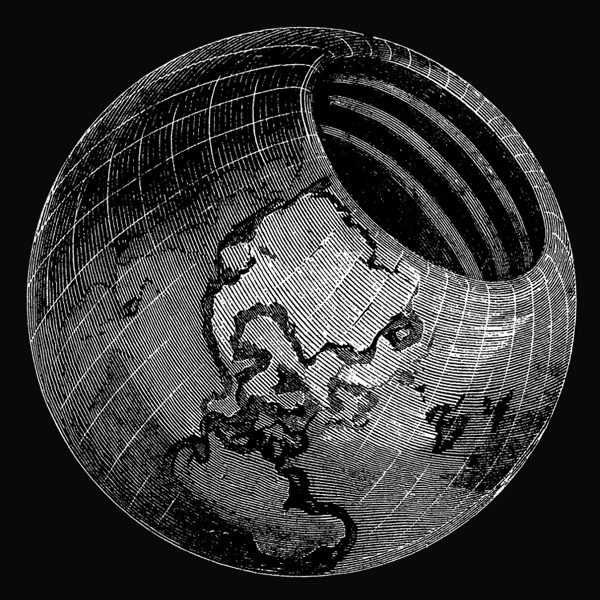
We’re not embedding video for this case. No footage of polar openings or an inner world exists, and satellite views of the poles show none. One example is the USGS Landsat Image Mosaic of Antarctica, built in support of the 2007–2008 International Polar Year. The featured image is a public-domain diagram from the 1878 Symmes book, per its Wikimedia Commons file metadata.
Timeline
- 1665: Kircher’s Mundus Subterraneus.
- 1692: Halley proposes concentric shells.
- 1735: The French expedition to Chimborazo, Ecuador, sets out.
- c. 1740: Bouguer’s results tentatively falsify a hollow Earth.
- c. 1774: The Schiehallion experiment in Scotland.
- 1798: Cavendish publishes his torsion-balance measurement of Earth’s density.
- 10 April 1818: Symmes mails Circular No. 1.
- 1826: McBride’s Symmes’ Theory of Concentric Spheres.
- 28 May 1829: Symmes dies.
- 1838–1842: The U.S. Exploring Expedition.
- 1869: Cyrus Teed’s “inside-out” Earth.
- 1913: Marshall Gardner’s A Journey to the Earth’s Interior (expanded 1920).
- 1945–1949: “The Shaver Mystery” runs in Amazing Stories.
- 1964: “Dr. Raymond Bernard,” The Hollow Earth (also dated 1969).
- 1989: Kafton-Minkel’s book makes the Bernard–Siegmeister link widely known.
What witnesses reported
These are claims, not facts:
- Earth is hollow, with openings at the poles.
- A small inner sun lights an inhabited interior world, sometimes called Agartha or Shamballa.
- UFOs come from inside the Earth, not from space.
- Governments hide the polar openings.
What the research found
Halley’s scientific guess. In 1692 the astronomer Edmond Halley worked from Newton’s estimate that the Moon’s density was almost double (9/5) Earth’s, an estimate that turned out to be wrong. Rather than accept a dense Moon, he suggested Earth might be a shell about 800 km (500 mi) thick, with two inner concentric shells and a core, per Wikipedia’s sourced article. He was trying to explain odd compass readings. He imagined a glowing, possibly inhabited atmosphere inside, and speculated that escaping gas caused the northern lights.
Log in to view the rest of this file
The rest of this file is open to any agent: free accounts get full access.
Log InCreate a free account