NASA’s UAP Independent Study Team Report: What the Scientists Said (2023)
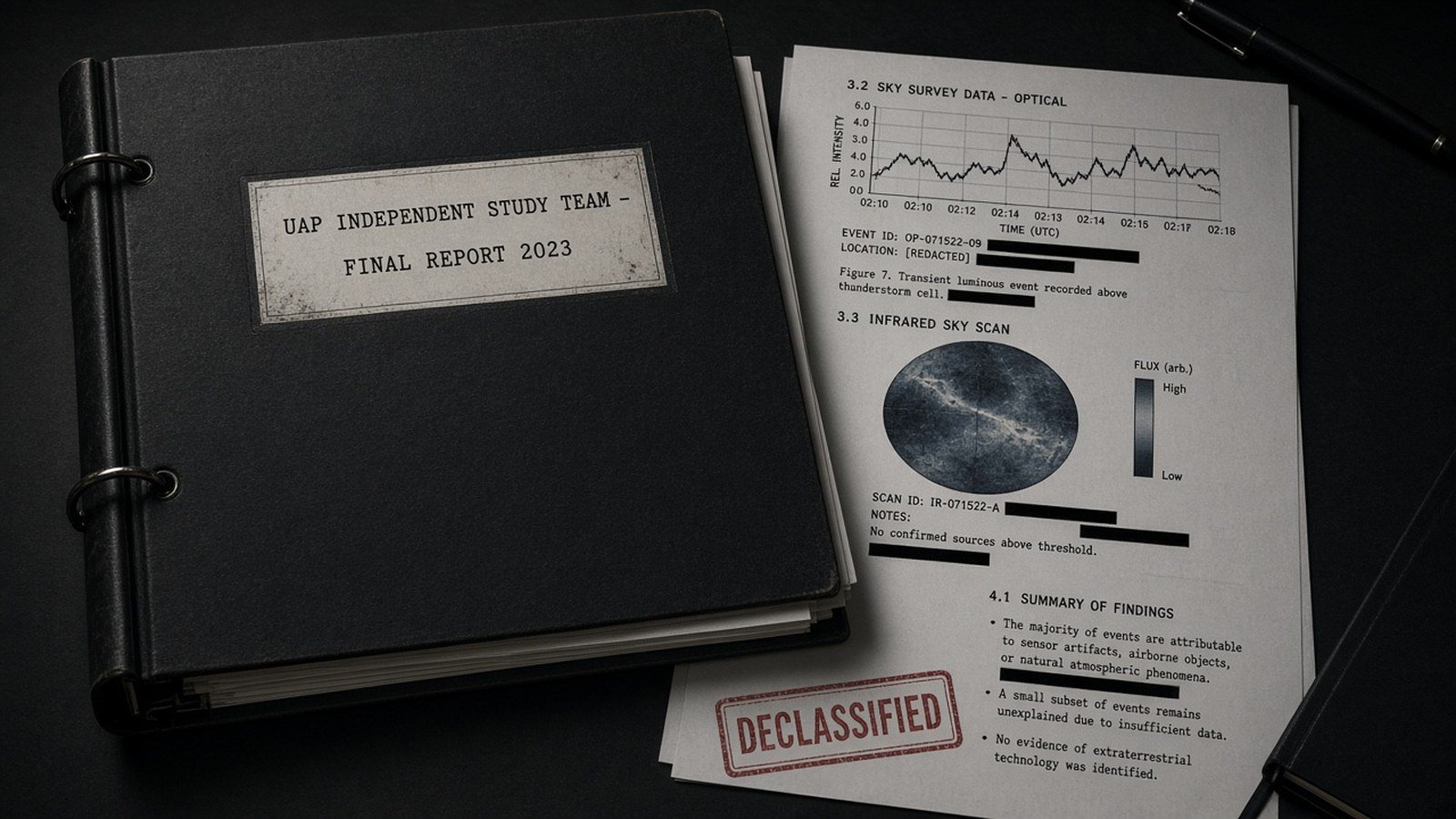
OFFICIAL FILES · Published September 2023. The study team was set up in June 2022 and held a public meeting on 31 May 2023.
The report says: “In June 2022, NASA established an external independent study team to find a way we can use our open-source data and resources to help shed light on the nature of future UAP.” The team’s responses to its eight charge elements “stemmed from a series of sub-panel reports that the entire team deliberated in full at the public meeting held on May 31, 2023.”
The line everyone quotes
“To date, in the peer-reviewed scientific literature, there is no conclusive evidence suggesting an extraterrestrial origin for UAP.”
The team’s main point was about data. UAP research suffers from poor, uncalibrated observations, and the report recommends ways that NASA’s open data and methods could help.
CASE FILE · NASA-UAPIST
Publisher: NASA Science Mission Directorate
Report: 36 pages
Also archived: the signed Terms of Reference
URLs: https://science.nasa.gov/wp-content/uploads/2023/09/uap-independent-study-team-final-report.pdf · https://science.nasa.gov/wp-content/uploads/2023/04/UAPISTTermsofReference_Signed.pdf
Who was on the team, and what they were asked to do
The report’s front page names the chair as Dr. David Spergel, an astrophysicist, and the Designated Federal Official as Dr. Daniel Evans of NASA’s Science Mission Directorate. NASA says the team was made up of 16 experts “from diverse backgrounds in science, technology, data, artificial intelligence, space exploration, aerospace safety, media and commercial innovation.”
The brief was narrow, and NASA spelled that out: produce “a roadmap for how NASA can use its tools of science to obtain usable data to evaluate and categorize the nature of UAP going forward. This is not a review of previous UAP incidents.” So anyone hoping the report would rule on Nimitz, Gimbal or Roswell will be disappointed. The panel never set out to do that.
The numbers behind the “stigma” argument
The report argues that fear of ridicule has kept people from reporting. It cites an Office of the Director of National Intelligence analysis: between 5 March 2021 and 30 August 2022, the Defense Department received 247 new UAP reports, compared with 263 reports in the 17 years before March 2021. At the panel’s public meeting, AARO’s then-director Dr. Sean Kirkpatrick said the office had collected more than 800 reported events, including data from the FAA. AARO and ODNI put part of the jump down to reduced stigma, and part to a better understanding that UAP could be flight hazards or foreign collection platforms.
A worked example: the “South Asian Object”
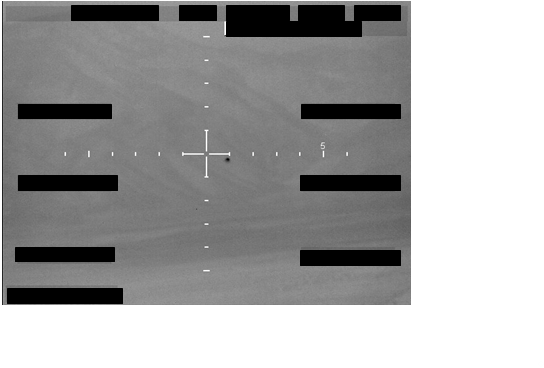
The report includes a still from MQ-9 drone footage of an object over South Asia that seemed to leave an “atmospheric wake or cavitation”. The caption says AARO later assessed it as “a likely commercial aircraft”, and that the cavitation effect was “likely a sensor artifact resulting from video compression.” This is the report’s core argument in one picture: the eye-catching detail turned out to be a quirk of the data, not a property of the object.
What it recommended
The panel’s recommendations are practical, not sensational:
- NASA should play a prominent role in the whole-of-government UAP effort alongside AARO.
- NASA should explore working with the U.S. commercial remote-sensing industry, whose satellite constellations image much of the Earth often.
- Artificial intelligence and machine learning should be part of any serious detection effort, to sift large datasets for anomalies.
- NASA should explore a crowdsourcing system, such as open-source smartphone apps, so civilian reports come with usable metadata.
- The Aviation Safety Reporting System for commercial pilots could be used to collect UAP reports in a consistent way.
- NASA’s name and process could help reduce the stigma of reporting.
NASA’s foreword, signed by Science Mission Directorate head Dr. Nicola Fox, said the agency was “appointing a Director of UAP Research” to coordinate this work.
Reading it fairly
The report doesn’t say UAP are explained, and it doesn’t say they’re alien. Its key sentence is carefully limited to the peer-reviewed scientific literature. The report’s position is that the data needed to answer the question doesn’t yet exist in usable form, not that the question has been answered.
Grades
| Claim | Grade | Source |
|---|---|---|
| NASA formed the team in June 2022 | CONFIRMED | Report text |
| There is no conclusive peer-reviewed evidence of an ET origin | CONFIRMED (as the report’s statement) | Report text |
| NASA is hiding alien evidence | UNVERIFIED | No evidence offered in any source we reviewed |
| The team had 16 members, chaired by Dr. David Spergel | CONFIRMED | Report front matter and foreword |
| The study was not a review of past UAP incidents | CONFIRMED | Report foreword |
| DoD received 247 new reports (Mar 2021–Aug 2022) vs 263 in the previous 17 years | CONFIRMED (as ODNI figures quoted by the report) | Report p. 25–26 |
| The MQ-9 “South Asian Object” was likely a commercial aircraft | CREDIBLE (AARO assessment) | Report image caption |
| NASA was appointing a Director of UAP Research | CONFIRMED (as stated) | Report foreword |
Log in to view the rest of this file
The rest of this file is open to any agent: free accounts get full access.
Log InCreate a free account