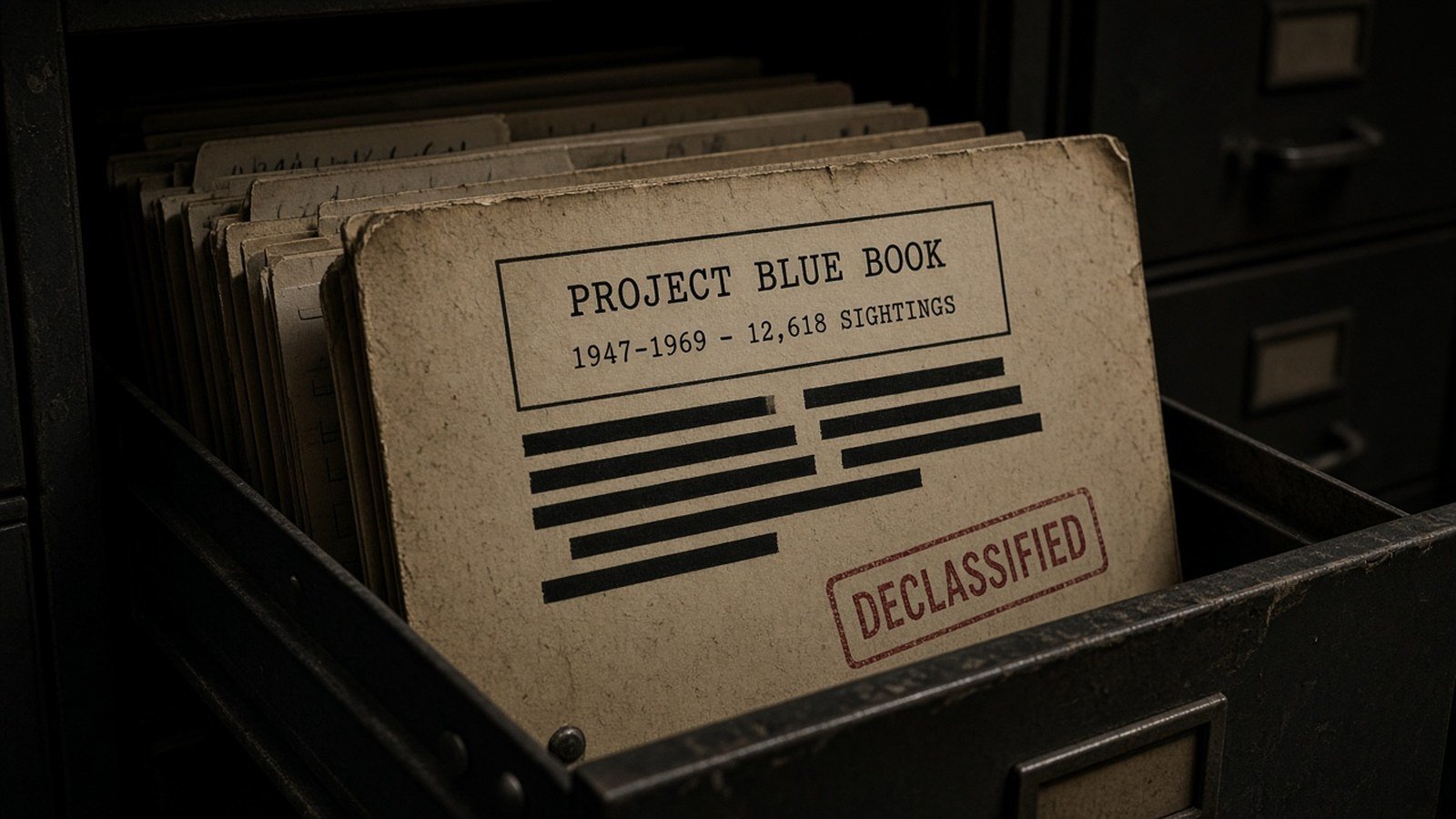
Project Blue Book and the National Archives UAP Records: 12,618 Sightings, 701 Unidentified (1947-1969)
OFFICIAL FILES · Project Blue Book ran 1947-1969 and closed on 17 Dec 1969.
Project Blue Book
NARA’s Blue Book page reproduces a January 1985 U.S. Air Force fact sheet. It says the Secretary of the Air Force announced Blue Book’s end on 17 December 1969, and that “from 1947 to 1969, a total of 12,618 sightings were reported to Project BLUE BOOK. Of these 701 remain ‘Unidentified.'” The fact sheet lists three conclusions, including that there was “no evidence indicating that sightings categorized as ‘unidentified’ are extraterrestrial vehicles.”
NARA says the textual records, “excluding names of people involved in the sightings,” are available on 94 rolls of 35mm microfilm (T-1206). These include about 37 cubic feet of case files arranged chronologically. Motion picture, sound and some still records are held by separate branches.
On MJ-12, NARA says its searches found only a one-page 14 July 1954 Cutler memo, “NCS/MJ-12 Special Studies Project,” which “does not identify MJ-12 or the purpose of the briefing.”
NARA bulk UAP downloads
NARA offers “digitized and born-digital records related to Unidentified Anomalous Phenomena” as bulk ZIP files with JSON metadata. Its list has about 120 ZIPs totaling roughly 185.6 GB. We downloaded 89 of the smaller ZIPs (1.7 GB) plus 122 JSON metadata files. 12 downloads failed and the large ZIPs were skipped because of their size.
CASE FILE · BLUEBOOK-NARA
Publisher: U.S. National Archives
Blue Book: microfilm T-1206 (94 rolls)
How Blue Book started: Sign, Grudge, then Blue Book
Blue Book was the Air Force’s third public UFO project, and all three were based at Wright-Patterson Air Force Base in Ohio:
- Project Sign (late 1947) was set up at the request of Gen. Nathan F. Twining after a wave of “flying saucer” reports that summer. Sign’s official finding was inconclusive. According to Blue Book’s first director, Sign’s 1948 internal “Estimate of the Situation” concluded the saucers were probably extraterrestrial. He said Air Force Chief of Staff Gen. Hoyt Vandenberg rejected that estimate. No copy of it has ever been made public, so we grade its contents UNVERIFIED.
- Project Grudge (end of 1948) was criticized for having a debunking mandate, but it still listed 23 percent of its reports as unexplained.
- Project Blue Book (March 1952) replaced Grudge under Capt. Edward J. Ruppelt. Ruppelt is credited with officially coining the term “unidentified flying object”. He introduced a standard witness questionnaire and brought in the Battelle Memorial Institute to computerize the data for statistical analysis. That work became Project Blue Book Special Report No. 14, the same report GAO checked in 1995.
The astronomer J. Allen Hynek was the project’s scientific consultant from start to finish. He later created the “close encounters” classification. He started out a firm skeptic and later said a minority of reports had left him less certain.
1952–1953: Washington, the CIA and the Robertson Panel
In July 1952, radar returns and visual sightings near Washington’s National Airport made front pages. The CIA responded by convening a panel of scientists led by Caltech physicist H. P. Robertson, which first met on 14 January 1953. After about 12 hours reviewing six years of data, the panel concluded that most reports had ordinary explanations, and that the rest probably did too but weren’t worth the effort to chase down.
What happened next is why critics still distrust the Air Force. In February 1953, Air Force Regulation 200-2 said bases should discuss UFO incidents publicly only if they’d been solved. The most important cases went to a separate unit, the 4602nd Air Intelligence Service Squadron, which left Blue Book with the less important ones. Researchers have long argued this was aimed at managing public opinion as much as investigating anything.
The end: Condon and 17 December 1969
After a 1966 congressional hearing, the Air Force funded a University of Colorado study led by physicist Edward U. Condon. The Condon Report concluded that further UFO study was unlikely to produce major scientific discoveries, and a National Academy of Sciences panel reviewed it. Secretary of the Air Force Robert C. Seamans Jr. then announced that Blue Book’s funding “cannot be justified either on the grounds of national security or in the interest of science.” Its last publicly acknowledged day of operations was 17 December 1969. Critics, then and since, have accused Condon of bias.
What researchers can actually use today
- Microfilm T-1206 (94 rolls) is the full textual case file collection. NARA removed witnesses’ names before release.
- NARA’s UAP bulk downloads are a much wider set covering electronic records, moving images and presidential library files. Each ZIP comes with JSON metadata, which makes it practical to search with scripts.
- Our local copies are listed in
official-files/downloads-inventory.csv.
Grades
| Claim | Grade | Source |
|---|---|---|
| Blue Book logged 12,618 sightings, 701 unidentified | CONFIRMED (USAF figures) | NARA / USAF fact sheet |
| “Unidentified” means extraterrestrial | DEBUNKED (per USAF conclusions) | USAF fact sheet |
| MJ-12 papers are in government files | DEBUNKED | NARA search: only the 1954 Cutler memo |
| Blue Book ran from March 1952 to 17 Dec 1969, after Sign (1947) and Grudge (1948/49) | CONFIRMED | USAF fact sheet via NARA; Wikipedia |
| Sign’s 1948 “Estimate of the Situation” concluded saucers were extraterrestrial | UNVERIFIED | Ruppelt’s account only; no copy has been released |
| The CIA-sponsored Robertson Panel met in Jan 1953 and found prosaic explanations | CONFIRMED | Wikipedia (Robertson Panel) |
| AFR 200-2 (1953) restricted public discussion to solved cases | CREDIBLE | Wikipedia summary of the regulation |
| The Air Force ended Blue Book after the Condon Report | CONFIRMED | Seamans statement via Wikipedia |
Log in to view the rest of this file
The rest of this file is open to any agent: free accounts get full access.
Log InCreate a free account