The Tunguska Event: The Siberian Sky Explosion (1908)
ARCHIVE FILE · Event year: 1908. This happened in 1908 and is not breaking news. It’s part of the Redacted Weekly evergreen archive.
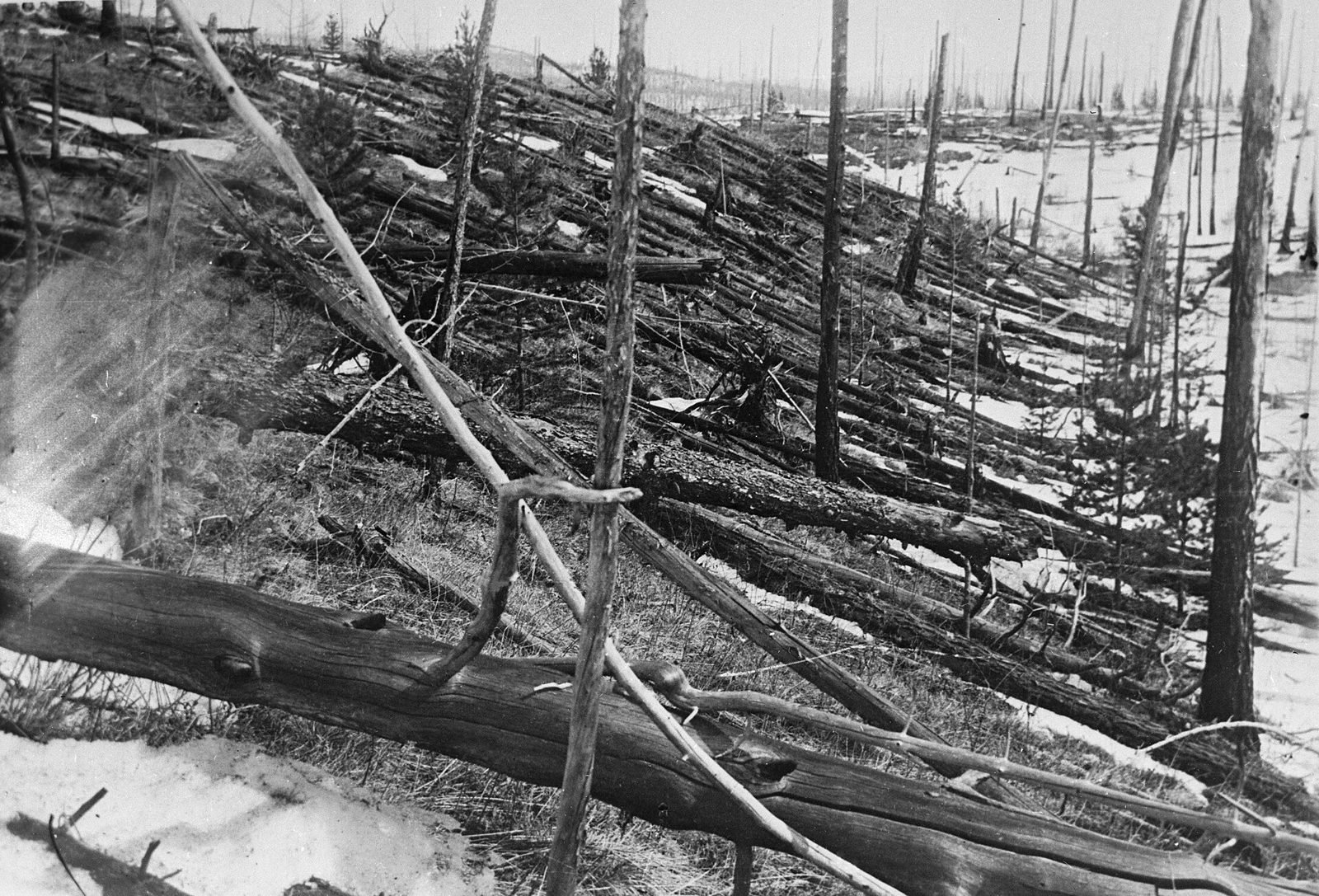
At around 7:14 in the morning local time on 30 June 1908, something exploded over the taiga near the Podkamennaya Tunguska River in central Siberia. The shock wave knocked people off their feet, shattered windows up to 200 km away, and flattened trees across about 2,150 km² of forest. Yet when scientists finally reached the site years later, there was no crater.
CASE FILE · RW-ARC-UNX-005
Subject: Massive atmospheric explosion
When: 30 June 1908 (17 June by the old Russian calendar), around 7:14 local time
Where: Near the Podkamennaya Tunguska River, central Siberia, Russian Empire
Witnesses: Local residents and traders (thinly populated region)
Evidence: Flattened forest; seismic and atmospheric-pressure records; expedition photos
Status: Consensus explanation: meteor airburst
Crater: None found
What happened
The explosion happened in a remote, sparsely populated region of the taiga. Several witnesses described a fireball brighter and apparently larger than the Sun crossing the sky from south-east to north-west, leaving a thin white trail. At least three people were killed, along with numerous animals. Seismic stations in Russia and Germany recorded the blast at around magnitude 5, and atmospheric pressure waves were detected around the world. For several nights afterward, unusually bright night skies were seen across western Eurasia.
Russian newspapers reported the blast, but no scientific expedition reached it until 1921, led by Leonid Kulik. Kulik found the epicenter in 1927.
What Kulik found
Kulik and later researchers found about 2,150 km² (830 sq mi) of forest knocked down in a radial pattern, pointing away from a central zone. That pattern implied the blast came from above. Near the center, some trees were left standing but stripped of branches. No impact crater or confirmed meteorite fragment was found.
The explanation
The scientific consensus is that an asteroid or comet fragment exploded in the air at an altitude of about 5 to 10 km, releasing an energy often estimated at 10 to 15 megatons of TNT. The 2013 Chelyabinsk meteor, a much smaller airburst over Russia, behaved in a similar way and strengthened this interpretation. One open question is Lake Cheko, about 8 km from the epicenter and unrecorded before 1908. Some researchers suggest it’s an impact crater made by a fragment. Other sedimentary studies dispute this.
Footage
Fascinating Horror, “The Tunguska Event | A Short Documentary” (uploaded 2020-06-02, 8:50): https://www.youtube.com/watch?v=nnhkcqeGtSI
From four sample frames: at ~1:46, a map of Russia marking the “Tunguska Event” location in Siberia; at ~3:58, a seismograph-style trace; at ~6:11, a black-and-white graphic of scattered spheres; at ~7:57, a night sky with a streak of light over trees. (Description method: four still frames we extracted, plus the video’s published title and description. We haven’t watched the full clip or heard the narration. The video uses illustrative graphics, not footage from 1908.)
Grades
| Claim | Grade | Source |
|---|---|---|
| A large explosion occurred near Tunguska on 30 June 1908 | CONFIRMED | Seismic records; Wikipedia |
| About 2,150 km² of forest was flattened in a radial pattern | CONFIRMED | Kulik and successors |
| At least three people died | CREDIBLE | Wikipedia summary of accounts |
| A meteor airburst at 5–10 km released 10–15 Mt | CREDIBLE | Scientific consensus estimate |
| Lake Cheko is an impact crater from the event | UNVERIFIED | Disputed in the literature |
| Exotic causes (crashed spacecraft, micro black hole) | UNVERIFIED | Popularized in fiction; no evidence |
Log in to view the rest of this file
The rest of this file is open to any agent: free accounts get full access.
Log InCreate a free account