The Queen Mary: Long Beach’s ‘Haunted’ Ocean Liner (1967–present)
ARCHIVE FILE · Event years: 1936–present. The ship’s history runs from 1936. The haunting stories date from the 1980s onward. This is not breaking news. It’s part of the Redacted Weekly evergreen archive.
The RMS Queen Mary carried passengers across the North Atlantic for Cunard from 1936 to 1967, served as a troopship in the Second World War, and then retired to Long Beach, California, as a hotel, museum and convention space. Today it’s also marketed as one of the most haunted places in America, with ghost tours, paranormal events, and a stateroom that was sealed for decades.
CASE FILE · RW-ARC-GHO-005
Subject: Multiple alleged ghosts aboard a retired ocean liner
When: Claims “began in earnest in the 1980s”
Where: RMS Queen Mary, Long Beach, California
Witnesses: Staff, guests, tour visitors
Evidence: Anecdotes; paranormal-tour reports
Status: Commercially active
Murders aboard in the historical record: None
The real tragedy
On 2 October 1942, while carrying thousands of American troops, the Queen Mary accidentally rammed and sliced through her escort, the light cruiser HMS Curacoa, off the Irish coast. 338 men were lost. It’s real history, with no ghost needed.
The ship’s real history
- 27 May 1936: Maiden voyage from Southampton. That August she won the Blue Riband for the fastest Atlantic crossing. She lost it to Normandie in 1937, took it back in 1938 and held it until 1952.
- 1940: She was converted to a troopship and painted navy grey. Between the paint and her speed, she got the nickname “Grey Ghost.” That’s the most documented “ghost” connected to the ship.
- 1943: On one voyage she carried more than 16,600 people, still the record for the most people aboard a single vessel.
- Wartime: She often sailed out of convoy, relying on speed and zigzag courses to outrun U-boats. She carried Winston Churchill across the Atlantic three times. He was listed on the manifest as “Colonel Warden.”
- 27 September 1967: She finished her 1,001st and last North Atlantic crossing, having carried about 2.1 million passengers. Long Beach bought her for $3.45 million. She left Southampton on 31 October and arrived in Long Beach on 9 December 1967.
- 8 May 1971: She opened to the public as a hotel and museum.
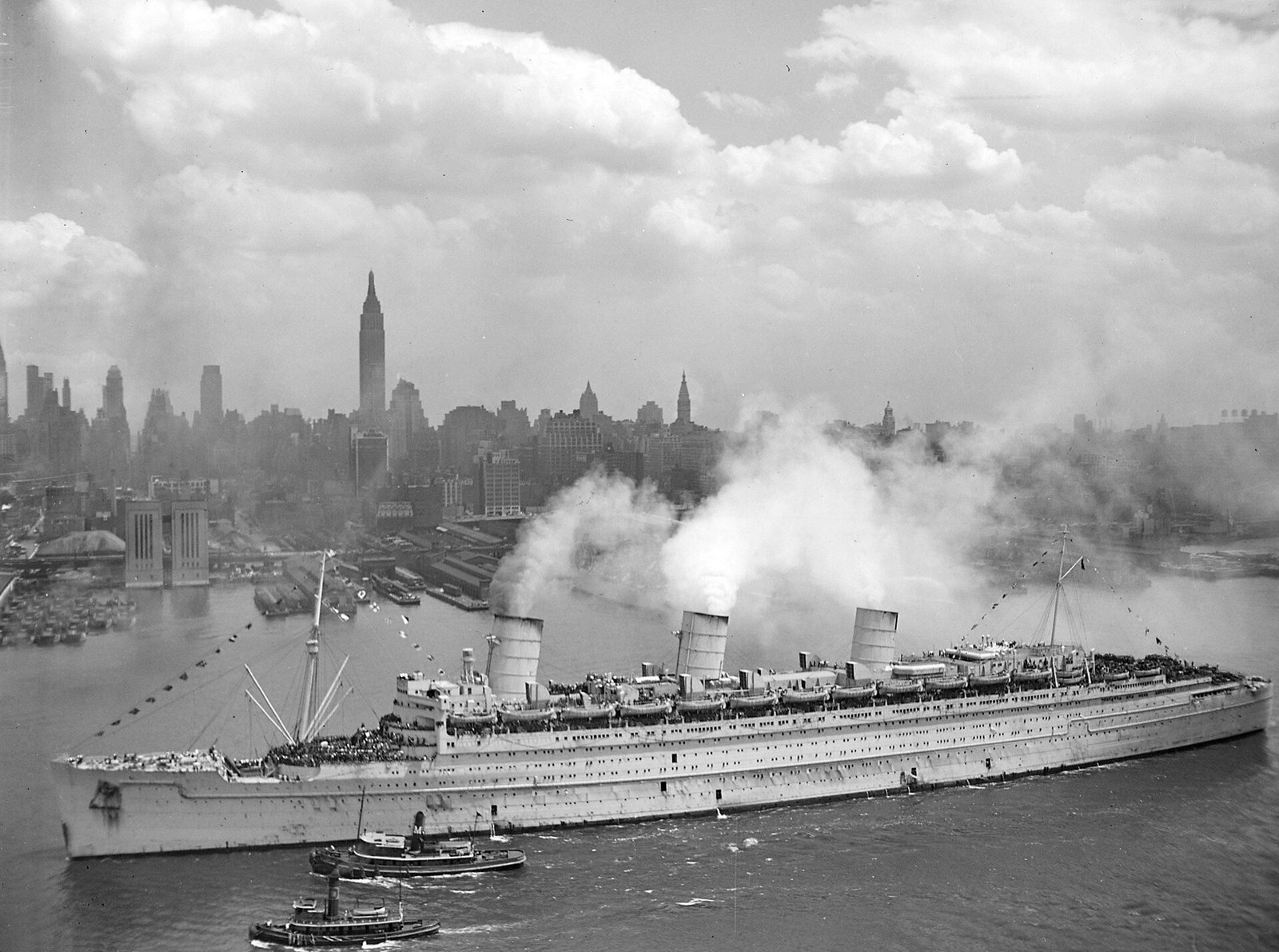
Our featured image is a public-domain U.S. Navy photo of her arriving in New York on 20 June 1945 with thousands of U.S. troops home from Europe, still in her grey wartime paint.
Pools, rooms and rewiring
The “young girl” legend centers on a swimming pool. The real pools went through a lot during the conversion. The second-class pool was removed and used for office space. The first-class pool was kept for viewing but couldn’t be used for swimming under modern safety codes, partly because the structure below it was weakened. To make room for a museum, the conversion also removed almost everything below “R” deck, including all the boiler rooms, the forward engine room and the stabilizers. The empty fuel tanks were filled with mud to keep the ship balanced. Only the aft engine room and shaft alley survived.
The real scare: her condition
The best-documented danger aboard is structural:
- 2017: A condition report found corrosion in the hull and interior supports, and areas such as the engine room at risk of flooding. Repairs were estimated at close to $300 million.
- August 2019: The city’s inspecting engineer said she was in the worst condition he had seen in 25 years, and warned that without major investment she would “likely soon be unsalvageable.”
- May 2020: She closed during the COVID-19 pandemic. A consultant hired by the city found she was vulnerable to flooding or even capsizing, and her rotted lifeboats were removed.
- June 2022: The city took control of repairs under a new management deal.
The legends
According to Wikipedia’s summary, the haunting claims began in earnest in the 1980s, possibly started by employees to drum up business or to spook guests. They’ve grown ever since. In 2008 Time put the ship on its “Top 10 Haunted Places” list. The stories include:
- A stateroom supposedly haunted by someone murdered there
- A young girl who haunts the former second-class swimming pool
- A father who murdered his two daughters on board
The famous room is Stateroom B340. According to CBS LA’s 2018 report, it had occasionally been used for paranormal tours but was otherwise sealed off from the public from the 1980s until the ship opened it for overnight stays in 2018.
Footage
CBS LA, “Queen Mary’s Most ‘Haunted’ Stateroom Available To Rent For First Time In 30 Years” (uploaded 2018-04-05, 2:53): https://www.youtube.com/watch?v=uzHjX3pCrxs
From four sample frames: at ~0:34, a hand holding up a printed document; at ~1:17, a man in a white officer’s uniform standing by the bed in a modernized stateroom; at ~2:01, the room’s bed and a wood-paneled wall; at ~2:35, a reporter standing in the room. The on-screen banner reads “Haunted Stateroom Opens to Guests.” (Description method: four still frames we extracted, plus the video’s published title and description. We haven’t watched the full clip or heard the audio.)
Grades
| Claim | Grade | Source |
|---|---|---|
| The Queen Mary sank HMS Curacoa on 2 Oct 1942 with 338 lives lost | CONFIRMED | Wikipedia, “RMS Queen Mary” |
| Haunting claims began in earnest in the 1980s | CONFIRMED | Wikipedia |
| Stateroom B340 was sealed from the 1980s and reopened for stays in 2018 | CREDIBLE | CBS LA, 2018 |
| Someone was murdered aboard (as the legends claim) | DEBUNKED | Wikipedia: no historical record; most deaths were natural |
| The ship is haunted | UNVERIFIED | Anecdotes only |
| Her wartime nickname was the “Grey Ghost” | CONFIRMED | Wikipedia, “RMS Queen Mary” |
| A 2017 report found serious corrosion and flooding risk | CONFIRMED | City condition reports, via Wikipedia |
Log in to view the rest of this file
The rest of this file is open to any agent: free accounts get full access.
Log InCreate a free account