Operation Northwoods: The Pentagon’s Rejected False-Flag Plan (1962)
ARCHIVE FILE · Event year: 1962 (made public 1997). This is not breaking news. It’s part of the Redacted Weekly evergreen archive.
If you’ve heard someone say “governments have planned false flags before,” this is usually the document they mean. Operation Northwoods was a set of proposals drafted by the U.S. Joint Chiefs of Staff in 1962 to stage or fake attacks, blame them on Cuba, and use them to justify a war against Fidel Castro’s government. It’s real, it’s declassified, and it was never carried out.
CASE FILE · RW-ARC-HIS-002
Subject: Proposed false-flag operations against Cuba
Presented: 13 March 1962, to Secretary of Defense Robert McNamara
Signed by: Gen. Lyman Lemnitzer, Chairman of the Joint Chiefs
Outcome: Rejected by President Kennedy
Made public: 18 November 1997, by the JFK Assassination Records Review Board
Status: Confirmed document; plan not executed
Paperwork: Disturbingly well organized
The context
Fidel Castro took power in Cuba in 1959. His government let communists into its ranks, nationalized U.S. businesses and moved closer to the Soviet Union, which alarmed the U.S. military. Northwoods was drafted as part of the government’s broader anti-Castro Cuban Project.
What the memo proposed
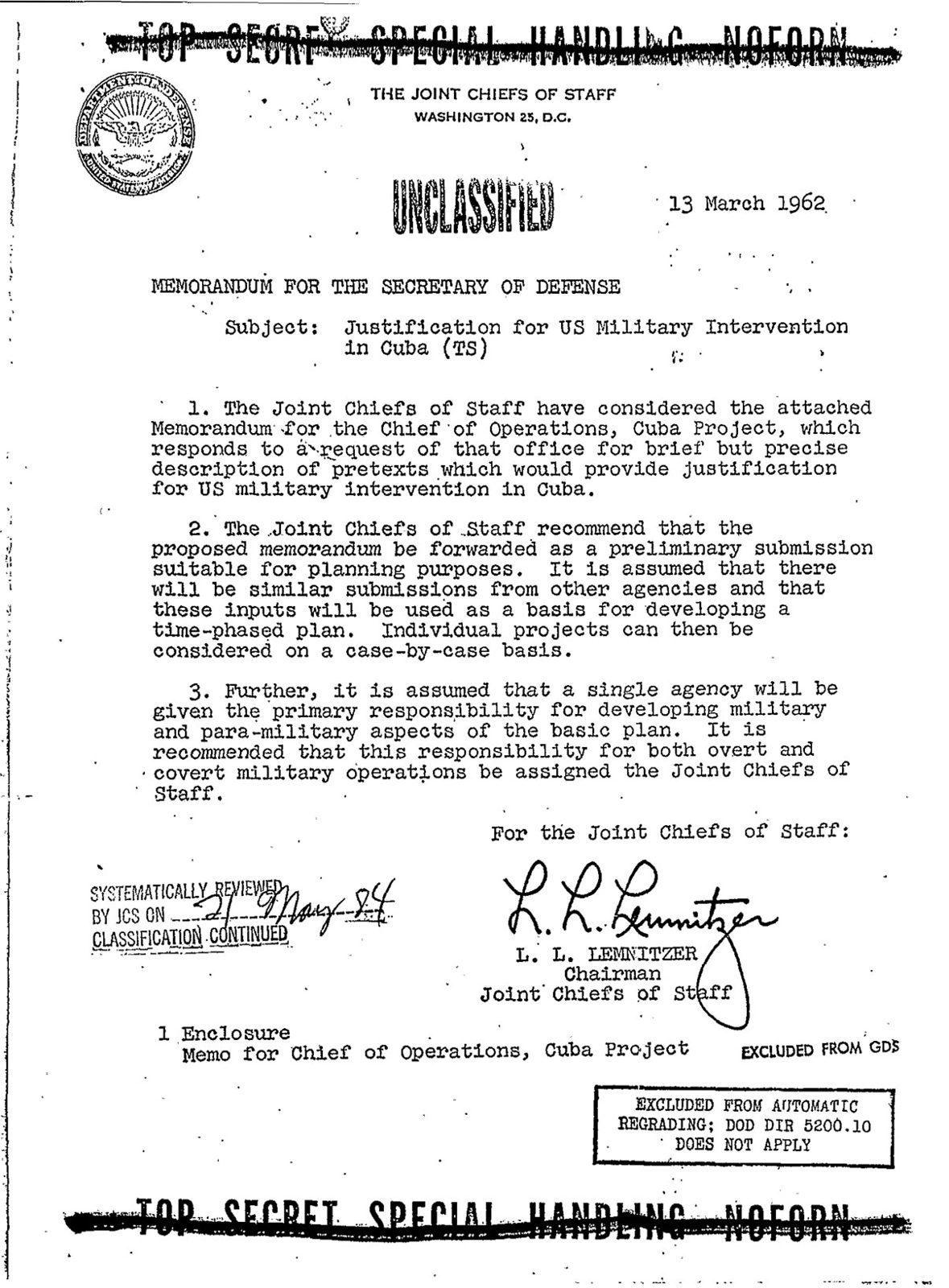
The document was presented by the Joint Chiefs to Secretary of Defense Robert McNamara on 13 March 1962 as a preliminary submission for planning purposes. It was signed by Chairman Lyman Lemnitzer. The ideas it listed included:
- staging or committing acts of terrorism against U.S. military and civilian targets and blaming Cuba
- hijackings and bombings followed by planted false evidence
- remote-controlled civilian aircraft secretly repainted to look like U.S. Air Force planes
- blaming Cuba for “hostilities” against the U.S. base at Guantanamo
- exploding a U.S. ship
In the memo’s own words, the desired result was “to place the United States in the apparent position of suffering defensible grievances from a rash and irresponsible government of Cuba.”
What happened next
The Joint Chiefs approved the proposals, but they were rejected by President John F. Kennedy, and Northwoods was never officially accepted. The memo stayed classified until 18 November 1997, when the John F. Kennedy Assassination Records Review Board made it public, along with 1,521 pages of once-secret military records from 1962-1964. It reached a broad audience in 2001 through James Bamford’s book Body of Secrets.
Who asked for pretexts
Northwoods didn’t come out of nowhere. It was a reply to a request for pretexts for military intervention from Brig. Gen. Edward Lansdale, chief of operations of the Cuban Project, also known as Operation Mongoose. Mongoose produced other proposals in the same vein:
- A 2 February 1962 memo by Brig. Gen. William H. Craig, “Possible Actions to Provoke, Harass or Disrupt Cuba,” listed twelve ideas.
- Operation Bingo was a plan to “create an incident which has the appearance of an attack on U.S. facilities (GMO) in Cuba.”
- Operation Dirty Trick proposed that if John Glenn’s 1962 Mercury orbital flight failed, the U.S. would manufacture “various pieces of evidence which would prove electronic interference on the part of the Cubans.”
None of these were carried out either. Glenn’s Friendship 7 flight in February 1962 succeeded, so Dirty Trick’s trigger never happened.
What Kennedy said
A Lansdale memo titled “Meeting with the President, 16 March 1962” records Lemnitzer telling Kennedy that the military had “plans for creating plausible pretexts to use force.” According to the memo, Kennedy replied “bluntly that we were not discussing the use of military force.”
Lemnitzer left his post as Chairman of the Joint Chiefs later that year. Wikipedia describes this as Kennedy removing him. He became NATO’s Supreme Allied Commander in January 1963.
The ideas didn’t stop in 1962
A 1963 Defense Department paper discussed staging a “contrived ‘Cuban’ attack” on a member of the Organization of American States, with Jamaica and Trinidad-Tobago among the suggested targets. The paper itself warned that such schemes were “inherently, extremely risky in our democratic system in which security can be maintained, after the fact, with very great difficulty.” In other words, its authors expected that a staged attack would be hard to keep secret afterward.
How the paper trail came out
- 1992: The JFK Assassination Records Collection Act led to the declassification of millions of pages, Northwoods among them.
- 18 November 1997: The Review Board released it.
- 6 November 1998: The National Security Archive posted the false-flag annex online alongside CNN’s Cold War series.
- 30 April 2001: The Archive posted a fuller version with the cover memos.
- 3 August 2001: Cuba’s National Assembly issued a statement condemning Northwoods and Mongoose.
Footage
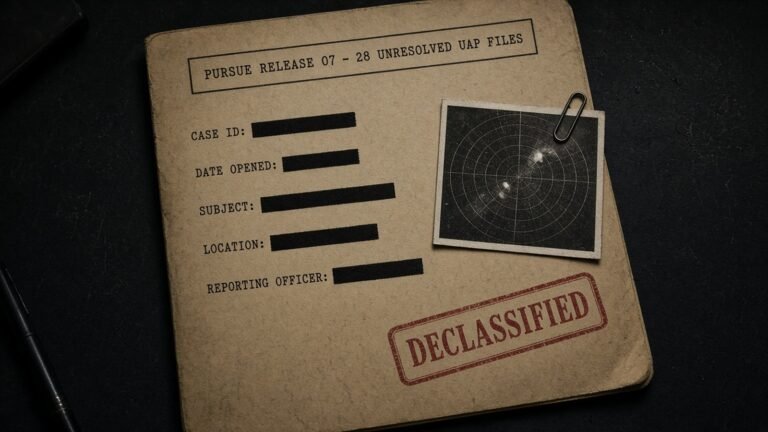
There’s no footage. The evidence is the memo itself, and a photo of it is the featured image. (Description method: Commons file metadata and the published memo text as quoted in secondary sources. We haven’t inspected the National Archives original.)
Grades
| Claim | Grade | Source |
|---|---|---|
| The Joint Chiefs drafted false-flag proposals against Cuba | CONFIRMED | Declassified memo (ARRB, 1997) |
| It was presented to McNamara on 13 Mar 1962 | CONFIRMED | Memo; Wikipedia |
| JFK rejected it | CONFIRMED | Historical record |
| Any Northwoods proposal was carried out | UNVERIFIED | No evidence |
| “Northwoods proves [modern event X] was a false flag” | UNVERIFIED | A 1962 proposal isn’t evidence about later events |
| Operation Mongoose produced similar pretext ideas (Bingo, Dirty Trick) | CONFIRMED | Declassified DoD memo, 2 Feb 1962 (via Wikipedia) |
| Kennedy rejected military force at a 16 Mar 1962 meeting | CONFIRMED | Lansdale memorandum, 16 Mar 1962 |
| Kennedy removed Lemnitzer over Northwoods | CREDIBLE (he left the chairmanship in 1962; the motive is interpretation) | Wikipedia |
Log in to view the rest of this file
The rest of this file is open to any agent: free accounts get full access.
Log InCreate a free account