The Gulf of Tonkin Incident: The Attack That Wasn’t (1964)
ARCHIVE FILE · Event dates: 2 and 4 August 1964 (NSA study declassified 2005). This is not breaking news. It’s part of the Redacted Weekly evergreen archive.
Two U.S. destroyers, a dark night in the Gulf of Tonkin, and radar screens full of contacts. The ships fired for hours. Congress voted within days. The problem, confirmed decades later by the government’s own codebreakers, is that the enemy boats on the night that mattered weren’t there.
CASE FILE · RW-ARC-HIS-005
Subject: The Gulf of Tonkin incident
Ships: USS Maddox and USS Turner Joy
Dates: 2 August 1964 (real clash), 4 August 1964 (reported attack)
Result: Gulf of Tonkin (Southeast Asia) Resolution, passed 7 August 1964
Confirmed by: NSA historical study, declassified 2005
Status: Confirmed: the second attack did not happen
Enemy on 4 August: Black water
The real clash: 2 August
The backdrop matters. On the night of 30 July 1964, South Vietnamese commandos raided a North Vietnamese radar station on Hòn Mê island. The next day the destroyer USS Maddox began a signals-intelligence patrol off the North Vietnamese coast.
On 2 August, three North Vietnamese torpedo boats engaged Maddox. This fight was real. Three North Vietnamese boats were damaged and four North Vietnamese sailors were killed. There were no U.S. casualties, and Maddox came away, in the record’s own words, “unscathed except for a single bullet hole.”
The phantom attack: 4 August
On 3 August, USS Turner Joy joined the patrol. On the evening of 4 August, both ships opened fire on radar returns, following intercepts that U.S. forces read as signs of an imminent attack. The task force commander, Capt. John Herrick, reported that the ships were under attack. He soon reported doubts about that.
Navy pilot James Stockdale flew overhead that night. In his 1984 book Love and War he wrote: “[I] had the best seat in the house to watch that event, and our destroyers were just shooting at phantom targets—there were no PT boats there … There was nothing there but black water and American fire power.”
The fast track to war
Within thirty minutes of the reported incident, President Johnson had decided on retaliatory airstrikes (Operation Pierce Arrow), which he publicly ordered early on 5 August. Congress was told the attack was “unprovoked” because the ships were in international waters. It wasn’t told that Maddox had been supporting intelligence for South Vietnamese raids.
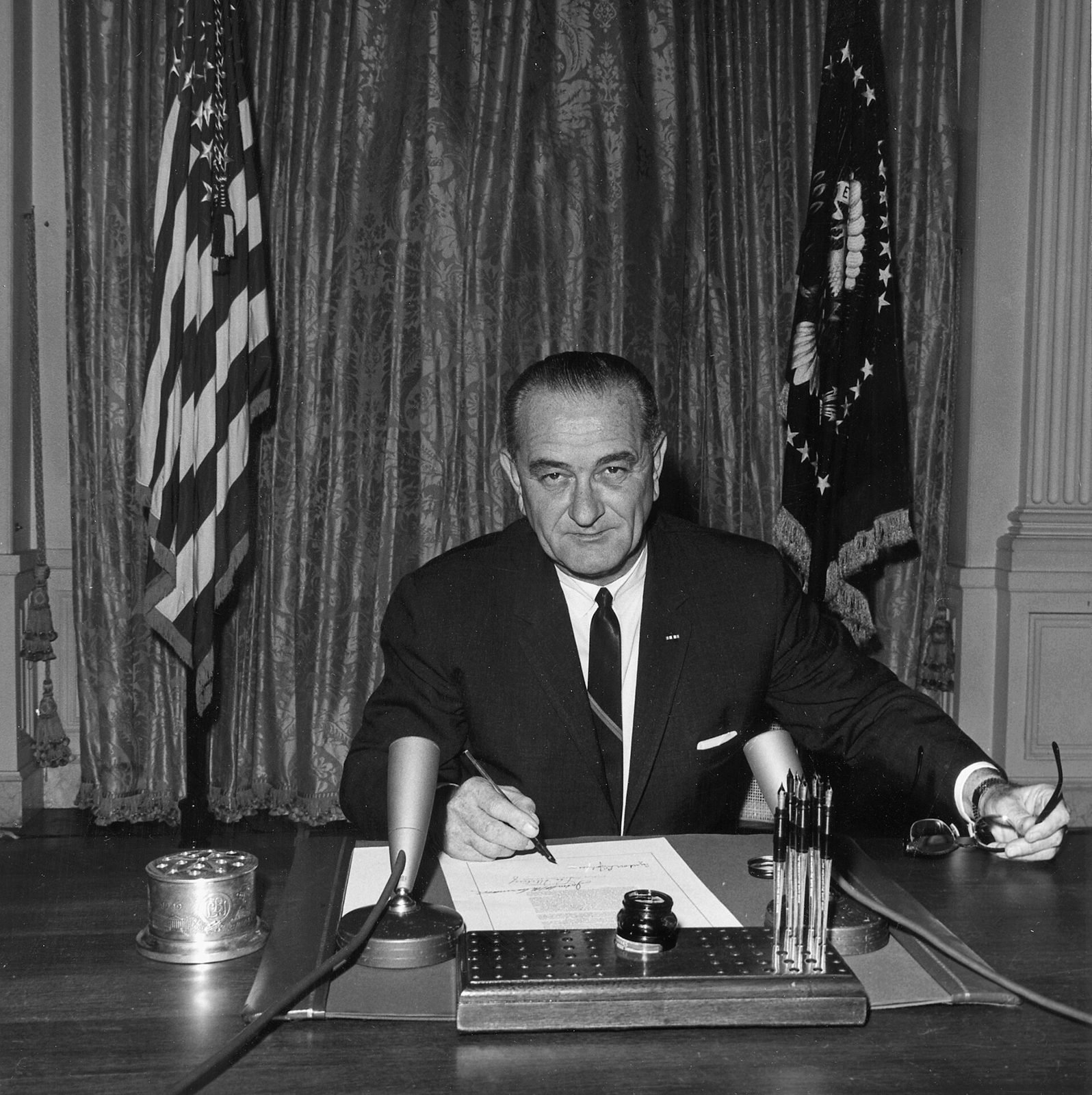
On 7 August, Congress passed the Southeast Asia Resolution (H.J. Res. 1145). It gave Johnson authority to conduct military operations in Southeast Asia without a declaration of war. He signed it on 10 August 1964, the moment in our featured photo. The resolution became the legal basis for the massive escalation of the Vietnam War.
How it came out
- 1995: McNamara met former North Vietnamese general Võ Nguyên Giáp and asked what happened on 4 August. Giáp’s answer: “Absolutely nothing.”
- 2003: In the documentary The Fog of War, McNamara admitted there had been no attack on 4 August.
- 2005: The NSA declassified an internal history by its historian Robert J. Hanyok. It concluded that Maddox had engaged the North Vietnamese Navy on 2 August, but the 4 August incident rested on bad naval intelligence and misrepresented North Vietnamese communications. The record also describes the NSA as having deliberately skewed intelligence shortly after the events, to make it look as though an attack had occurred.
Footage
We’re not embedding video for this case. Archival newsreels of Johnson’s 4 August address exist, but we haven’t verified a public-domain upload. (Description method: Wikimedia Commons file metadata for the featured photo; facts from Wikipedia’s sourced article and the NSA’s declassified Gulf of Tonkin materials, no footage viewed.)
Grades
| Claim | Grade | Source |
|---|---|---|
| North Vietnamese boats engaged USS Maddox on 2 Aug 1964 | CONFIRMED | NSA Hanyok study (2005); Wikipedia |
| North Vietnamese boats attacked U.S. destroyers on 4 Aug 1964 | DEBUNKED | NSA study; McNamara, The Fog of War (2003); Stockdale (1984) |
| Signals intelligence was skewed to support the attack story | CONFIRMED | NSA study (2005) |
| The resolution passed 7 Aug and was signed 10 Aug 1964 | CONFIRMED | National Archives photo record; Wikipedia |
| Johnson knowingly invented the attack | UNVERIFIED | The record shows haste and confusion. Deliberate invention by the President isn’t documented. |
Log in to view the rest of this file
The rest of this file is open to any agent: free accounts get full access.
Log InCreate a free account