The Patterson–Gimlin Film: Bigfoot’s Most Famous 59 Seconds (1967)
Subject: Large, hairy, upright figure (“Patty”)
Event: 20 October 1967 (per the filmmakers)
First report: Eureka Times-Standard, October 1967 · Last checked: 4 Nov 2026
Location: Bluff Creek, Six Rivers National Forest, northern California
Status · Grade: Contested; man in costume CREDIBLE
What happened
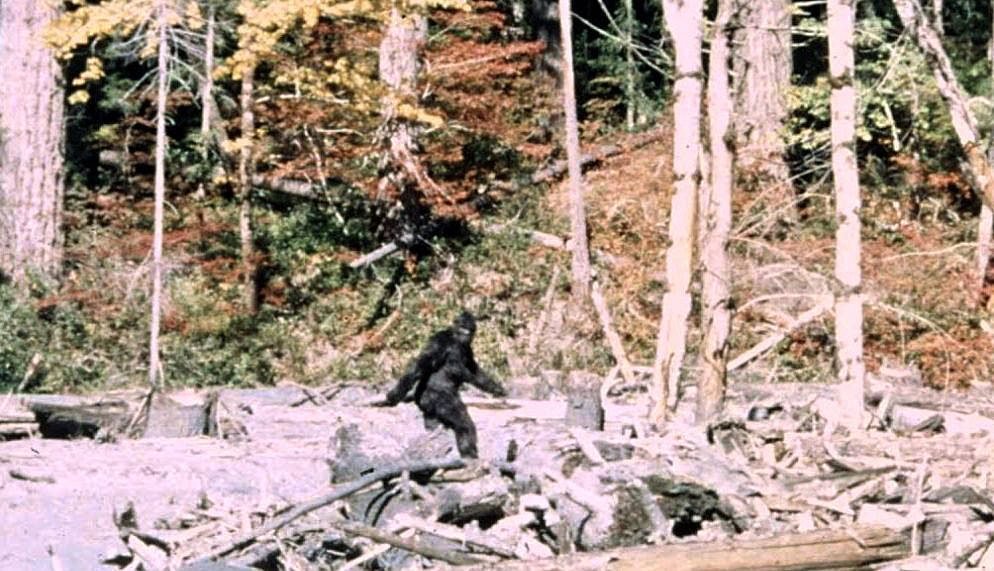
If you’ve ever pictured Bigfoot, you’ve probably pictured frame 352: a dark, hairy figure mid-stride, glancing back at the camera. It comes from a short 16mm film shot in northern California in 1967. Roger Patterson, a rodeo rider and Bigfoot enthusiast, returned to Bluff Creek, an area known for large-footprint reports, with his friend Bob Gimlin. According to the two men, on 20 October their horses spooked at a bend in the creek. Patterson jumped down with the camera and ran after a figure walking along a gravel bar. After the encounter, Patterson phoned the Eureka Times-Standard with his story.
The footage
The film is 23.85 feet long, preceded by 76.15 feet of horseback footage. It has 954 frames and runs 59.5 seconds at 16 frames per second. The camera was a Kodak K-100 rented on 13 May 1967 from a shop in Yakima.
The embedded clip is a third-party stabilization: “Bigfoot | Patterson–Gimlin Film | Stabilized | 10/20/1967,” uploaded by MojoPin1983 on 28 November 2016, 0:10 long. It credits stabilization work to M.K. Davis. It is not the camera original. According to film researcher Bill Munns, that original was last seen in 1980.
Timeline
- 1964: Patterson visits songwriter Jerry Lee Merritt, who later works with him on his Bigfoot documentary.
- 13 May 1967: He rents the K-100 camera.
- 20 October 1967: The Bluff Creek film is shot.
- 1971: The researcher René Dahinden takes the film to Europe for analysis.
- 1972: Patterson dies.
- 1976: The FBI tests hairs from a separate Bigfoot report and finds them to be “of deer family origin.”
- 1980: The camera original is last seen.
- 2002: Costume maker Philip Morris says he sold Patterson a gorilla suit.
- 2004: Bob Heironimus claims in Greg Long’s The Making of Bigfoot that he wore it.
- 2014: Munns publishes When Roger Met Patty; Sykes et al. publish their DNA study.
- 12 March 2026: Capturing Bigfoot premieres at SXSW.
What witnesses reported
Patterson said he came within 60 to 90 feet and that the figure “turned a total of I think three times.” He yelled “Cover me” to Gimlin. He later described the creature’s expression to researcher John Green as one of “contempt and disgust.” According to Wikipedia’s sources, Patterson “maintained right to the end that the creature on the film was real.” Gimlin has consistently said he was not part of any hoax.
What the research found
Frame rate. The camera’s speed decides how humanlike the walk looks. Primatologist John Napier wrote that “if the movie was filmed at 24 frame/s then the creature’s walk cannot be distinguished from a normal human walk.” Grover Krantz, who believed the film genuine, argued for 18 fps. Krantz said Patterson told John Green the camera had been set to 18. Others suggest Patterson misread 16 as 18.
Log in to view the rest of this file
The rest of this file is open to any agent: free accounts get full access.
Log InCreate a free account