The Tuskegee Syphilis Study: 40 Years of Withheld Treatment (1932-1972)
ARCHIVE FILE · Event years: 1932-1972 (exposed 1972). This is not breaking news. It’s part of the Redacted Weekly evergreen archive. It’s history, not medical advice.
Most stories in this archive get graded somewhere between “maybe” and “no.” This one is a flat yes. For forty years, a U.S. government health agency ran a study that depended on not treating sick men, and it lied to them about why they kept being examined.
CASE FILE · RW-ARC-HIS-003
Subject: “Tuskegee Study of Untreated Syphilis in the Negro Male”
Run by: U.S. Public Health Service (PHS), later with the CDC
Location: Macon County, Alabama
Dates: 1932 to 16 November 1972
Exposed by: PHS whistleblower Peter Buxtun and AP reporter Jean Heller
Status: Confirmed in the government’s own records
Consent forms: Not the kind that count
What the study was
In 1932 the PHS began following 600 Black sharecroppers from Macon County, Alabama. 399 had latent syphilis and 201 did not; they were the control group. The men were promised free medical care, meals, and burial insurance. They were never told they had syphilis. They were told they were being treated for “bad blood,” and what they got instead of treatment was placebos and diagnostic procedures.
The study’s purpose was to watch what untreated syphilis did to the human body over time. That made treating the men the one thing the study couldn’t allow.
The penicillin problem
By 1947, penicillin had become the standard treatment for syphilis. The study didn’t stop and didn’t offer it. According to the historical record, researchers went further and worked to keep participants from getting treatment elsewhere. The study went on for another 25 years.
How it ended
Peter Buxtun, a 29-year-old PHS employee, raised ethical objections internally starting in the 1960s. When that went nowhere, he took the story to the press. AP reporter Jean Heller broke it in the Washington Star on 25 July 1972. It ran on the front page of The New York Times the next day. The study was officially ended on 16 November 1972.
The documented toll: 28 participants died directly of syphilis and 100 of related complications. 40 wives were infected, and 19 children were born with congenital syphilis.
What changed
- After the exposé: Sen. Edward Kennedy called congressional hearings, and Buxtun testified at them.
- 1973: The class action Pollard v. United States ended in a $10 million settlement.
- 1974: Congress passed the National Research Act.
- 1979: The Belmont Report set out the core ethics rules for research on human subjects. Today’s informed-consent and institutional review board (IRB) rules grew out of it.
- 1997: President Bill Clinton formally apologized on behalf of the U.S. government: “What was done cannot be undone, but we can end the silence.”
Why it belongs in “Historical Conspiracies”
This was a conspiracy in the plain sense of the word: officials kept a decades-long program going by deliberately deceiving its subjects. The study also has a lasting legacy. Researchers have connected it to long-term distrust of medical institutions among Black Americans, and it’s a fixture in medical-ethics training.
Footage
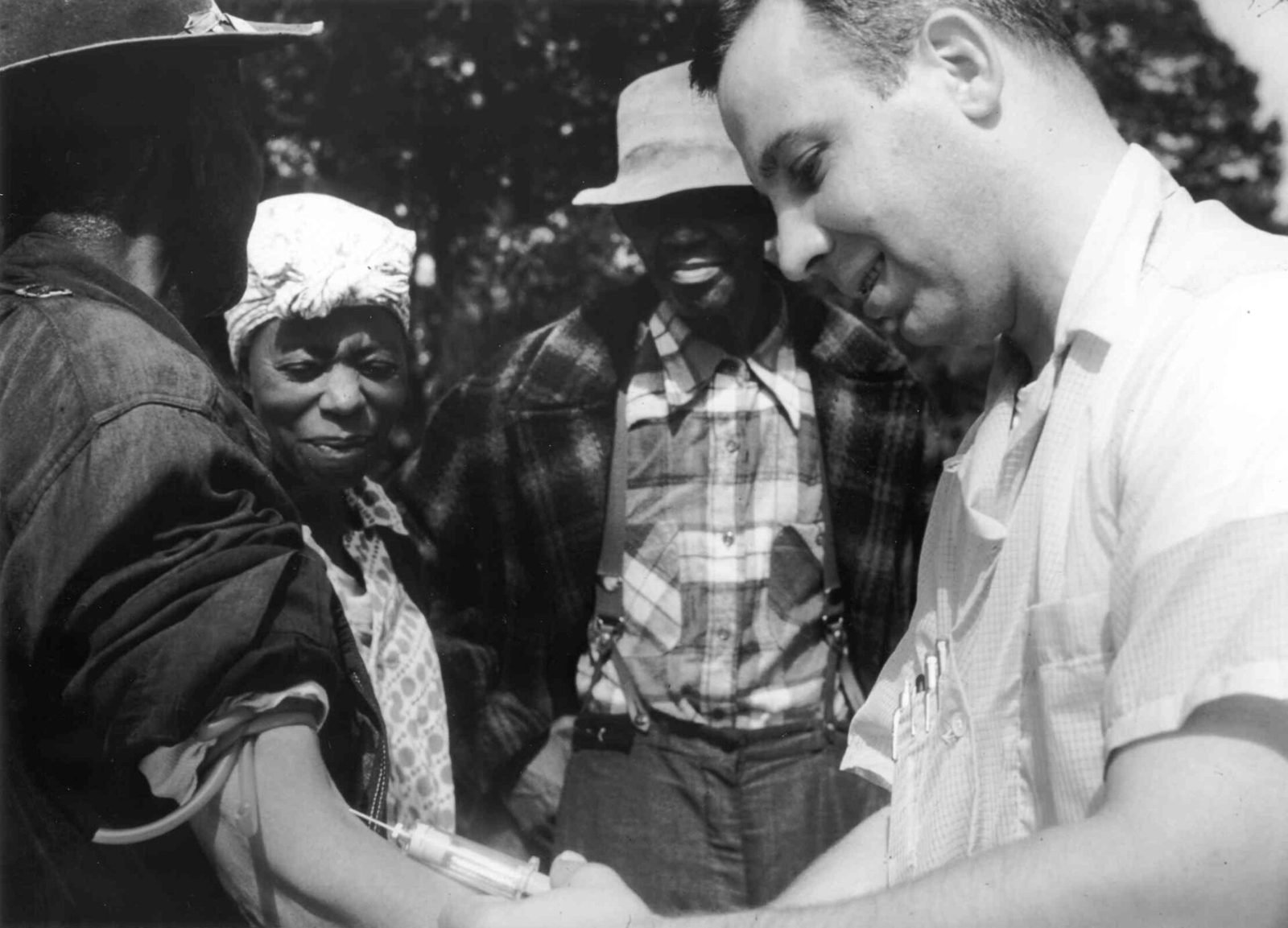
We’re not embedding video for this case. The featured image is a National Archives photograph from the study’s early years. (Description method: Wikimedia Commons file metadata and caption, “Doctor drawing blood from a patient as part of the Tuskegee Syphilis Study,” 1932. We didn’t do any independent image analysis.)
Grades
| Claim | Grade | Source |
|---|---|---|
| The PHS ran the study from 1932 to 1972 | CONFIRMED | CDC; Wikipedia |
| The men weren’t told their diagnosis and weren’t given effective treatment | CONFIRMED | CDC; Wikipedia |
| Penicillin was standard by 1947 and was withheld | CONFIRMED | CDC; Wikipedia |
| It was exposed by Buxtun and the AP’s Jean Heller in July 1972 | CONFIRMED | AP / Washington Star, 25 Jul 1972 |
| The government formally apologized in 1997 | CONFIRMED | Clinton White House remarks, 16 May 1997 |
| The men were deliberately infected with syphilis | DEBUNKED | Participants already had the disease. Deliberate infection did happen in the separate PHS Guatemala experiments (1946-48). |
Log in to view the rest of this file
The rest of this file is open to any agent: free accounts get full access.
Log InCreate a free account