The Record Neutrino That Might Have Come From a Black Hole in Another Dimension
Subject: Record-energy neutrino and the “fifth dimension” black-hole proposal
Event: KM3-230213A, 13 Feb 2023, 01:16:47 UTC
First report: Nature, 12 Feb 2025; Scientific American, 2 Oct 2026 · Last checked: 4 Nov 2026
Location: KM3NeT/ARCA, Mediterranean seabed off Sicily
Status · Grade: Detection CONFIRMED · 5D black hole UNVERIFIED
What happened
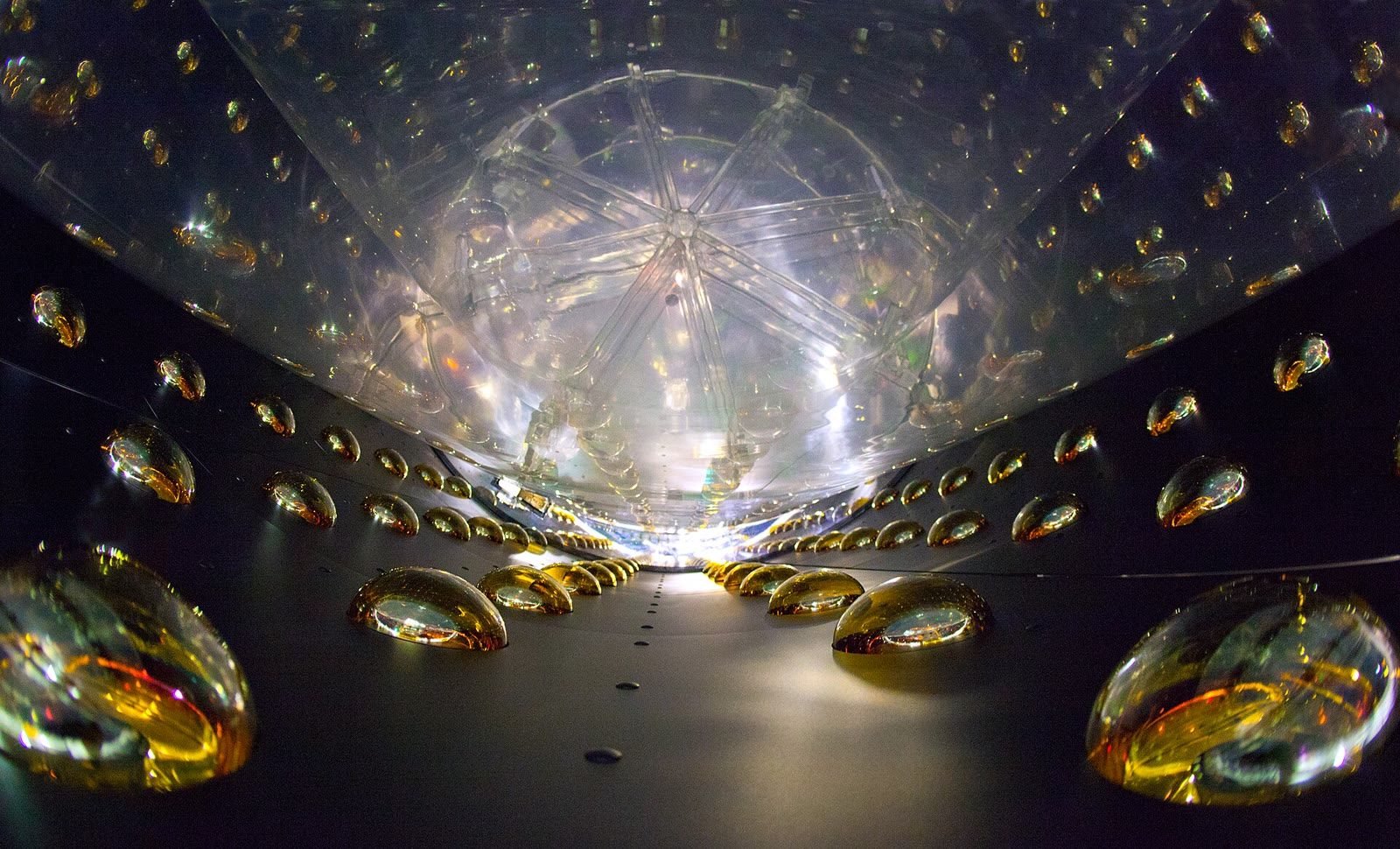
On 2 October 2026, Scientific American’s Jonathan O’Callaghan reported a new proposal about the most energetic neutrino ever seen. The particle, KM3-230213A, was caught in 2023 by the still-under-construction Cubic Kilometre Neutrino Telescope (KM3NeT) off Sicily. It was “about 35 times more energetic than any neutrino seen before.” A paper published in Physical Review D on 28 September 2026 argues that it came from a tiny primordial black hole that formed around cosmic strings and sat in an extra dimension, then exploded.
The footage
No video exists. The evidence is detector data: a near-horizontal muon track recorded by KM3NeT’s ARCA detector and reported in Nature. The Nature paper estimates the muon energy at about 120 PeV and the parent neutrino’s median energy at 220 PeV, with a 90% range of 72 PeV to 2.6 EeV.
Timeline
- 2011: IceCube in Antarctica begins full operation, with far more exposure than KM3NeT would have in 2023 (Scientific American).
- 2022–2023: Cumrun Vafa and colleagues develop the “dark dimension” idea, first as a 2022 preprint and published in 2023.
- 13 February 2023, 01:16:47 UTC: KM3NeT/ARCA records KM3-230213A.
- 12 February 2025: The KM3NeT collaboration publishes “Observation of an ultra-high-energy cosmic neutrino with KM3NeT” in Nature.
- March–September 2025: Klipfel and Kaiser (MIT) post, then publish in Physical Review Letters, a model in which a primordial black hole explodes about 2,000 AU from the Sun.
- 16 October 2025: Anchordoqui, Halzen and Lüst publish on primordial-black-hole neutrinos in extra-dimension theories (Phys. Rev. D 112, 083034).
- September 2026: IceCube work shows no matching high-energy neutrinos at the time of the event (Scientific American).
- 28 September 2026: Anchordoqui, Bedroya and Lüst publish “Primordial black holes are five dimensional.”
- 2 October 2026: Scientific American’s coverage.
What believers claim
Supporters say a five-dimensional black hole solves two puzzles at once. Co-author Dieter Lüst says the scenario would “completely resolve this puzzle” of why no photons came with the neutrino. “The reason we do not see it is that we live on a one-plus-three-dimensional brane, on which all other interactions—like electromagnetism—take place. The only force which can penetrate the fifth dimension is gravity.” Vafa calls the fifth dimension “not only plausible; it is derived, in some sense, with minimal assumptions from string theory ideas.”
What the research found
The detection itself is solid. Georgia Tech’s Ignacio Taboada told Scientific American that an instrument error or miscalculation is “very unlikely.” The KM3NeT result passed peer review in Nature.
Log in to view the rest of this file
The rest of this file is open to any agent: free accounts get full access.
Log InCreate a free account