The Battle of Los Angeles, 1942: The Night a City Fired 1,440 Shells at Nothing It Could Name
ARCHIVE FILE · Event year: 1942. This happened in 1942 and is not breaking news. It’s part of the Redacted Weekly evergreen archive.
CASE FILE RW-ARC-SL-048
Subject: Wartime air-raid alarm and antiaircraft barrage over Los Angeles
Dates: night of 24–25 February 1942
Location: Los Angeles County, California (Santa Monica, Culver City, Long Beach, downtown)
Status: Closed in the official record (false alarm, likely balloons); still cited as an early “UFO” case
See it first
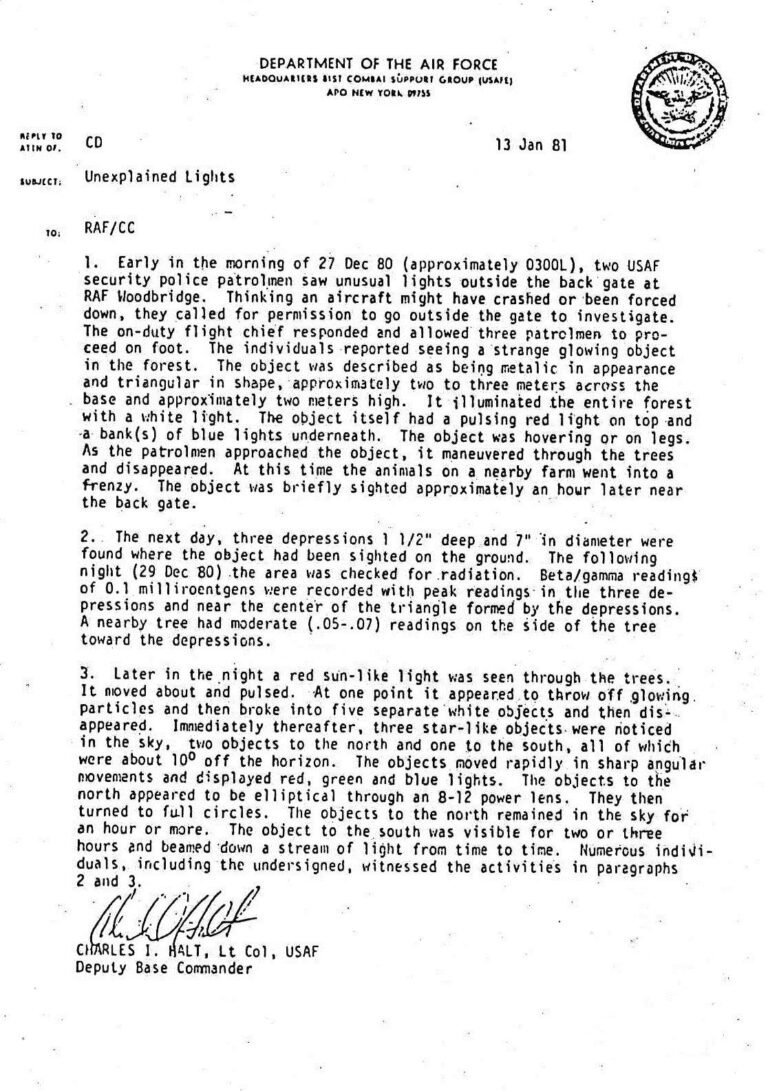
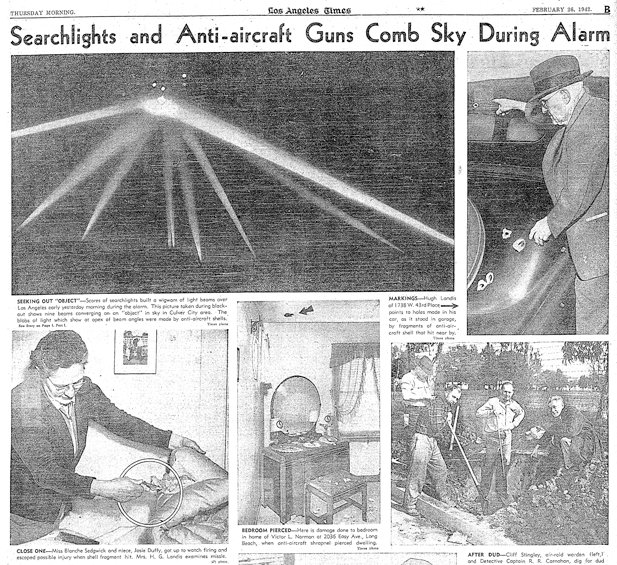
No surviving film of the barrage is held in the National Archives newsreel collection, which notes that most Universal Newsreel volumes for 1941–43 were lost in a 1978 fire (NARA newsreel guide). The best-known image is the searchlight photograph printed by the Los Angeles Times on 26 February 1942, shown at the top of this file. The Times has republished the original archive photographs in its own gallery, “From the Archives: The 1942 Battle of L.A.” (Scott Harrison, 2017). The paper’s own staff have explained that the famous print was heavily retouched before publication, so the “object” where the beams meet is partly a darkroom product.
What happened
Eleven weeks after Pearl Harbor, the West Coast was jumpy. On the evening of 23 February 1942, the Japanese submarine I-17 surfaced off Ellwood, near Santa Barbara, and shelled an oil facility. Damage was slight, but the message landed: the war could reach California.
The next day, according to the official history The Army Air Forces in World War II (Vol. 1, ch. 8), naval intelligence warned that an attack could be expected within ten hours. That evening, flares and blinking lights were reported near defense plants. An alert was called at 19:18 and lifted at 22:23.
Then, early on 25 February, radar picked up an unidentified target about 120 miles west of the city. Antiaircraft batteries were alerted at 02:15, the regional controller ordered a blackout at 02:21, and reports of aircraft over Long Beach began to arrive. A coast artillery colonel reported “about 25 planes at 12,000 feet.” At 03:06 a balloon carrying a red flare was seen over Santa Monica, four batteries opened fire, and, in the history’s words, “the air over Los Angeles erupted like a volcano.”
By the time the guns fell silent, 1,440 rounds of antiaircraft ammunition had gone up. Witnesses reported planes shot down and one crashing in flames at a Hollywood intersection. No wreckage was ever produced. Shell fragments fell on homes and streets, and the history records “at least one death from heart failure” plus traffic accidents. Secondary accounts put the civilian toll at five: three in car crashes and two from heart attacks.
Timeline
| Date / time (Pacific) | Event |
|—|—|
| 23 Feb 1942, ~7:15 pm | Submarine I-17 shells the Ellwood oil field near Santa Barbara |
| 24 Feb 1942 | Naval intelligence warns of a possible attack within 10 hours |
| 24 Feb, 7:18 pm–10:23 pm | First alert called, then lifted |
| 25 Feb, ~2:15 am | Radar contact 120 miles west; batteries alerted |
| 25 Feb, 2:21 am | Blackout ordered across the region |
| 25 Feb, ~3:06 am | Balloon with red flare reported over Santa Monica; firing begins |
| 25 Feb, ~4:14 am | Firing ends (per secondary accounts of the 37th Coast Artillery Brigade) |
| 25 Feb, 7:21 am | All clear |
| 25 Feb 1942 | Navy Secretary Frank Knox calls it a “false alarm” |
| 26–28 Feb 1942 | Front-page coverage and editorials in Los Angeles, Washington and New York |
| 10 Oct 1945 | In a US Strategic Bombing Survey interrogation in Tokyo, Cmdr. Masatake Okumiya’s evidence (cited by the AAF history) supports the Japanese statement that no planes were sent |
What believers claim
The modern legend says the guns were firing at a single large object that hung in the searchlights, took direct hits and kept going. The retouched Times photo is offered as proof, and the official mixed messages (Navy says false alarm, Army says planes were there) are read as a cover-up. In some retellings the object was not Japanese at all.
What the research found
The hooks: a city of two million under blackout, a barrage of 1,440 shells, a photograph that seems to show an object frozen in the searchlights, and two cabinet secretaries contradicting each other within 48 hours.
Log in to view the rest of this file
The rest of this file is open to any agent: free accounts get full access.
Log InCreate a free account