GAO’s 1995 Roswell Records Search: What Congress’s Auditors Found
OFFICIAL FILES · Report dated 28 July 1995 (B-262046), about events of July 1947.
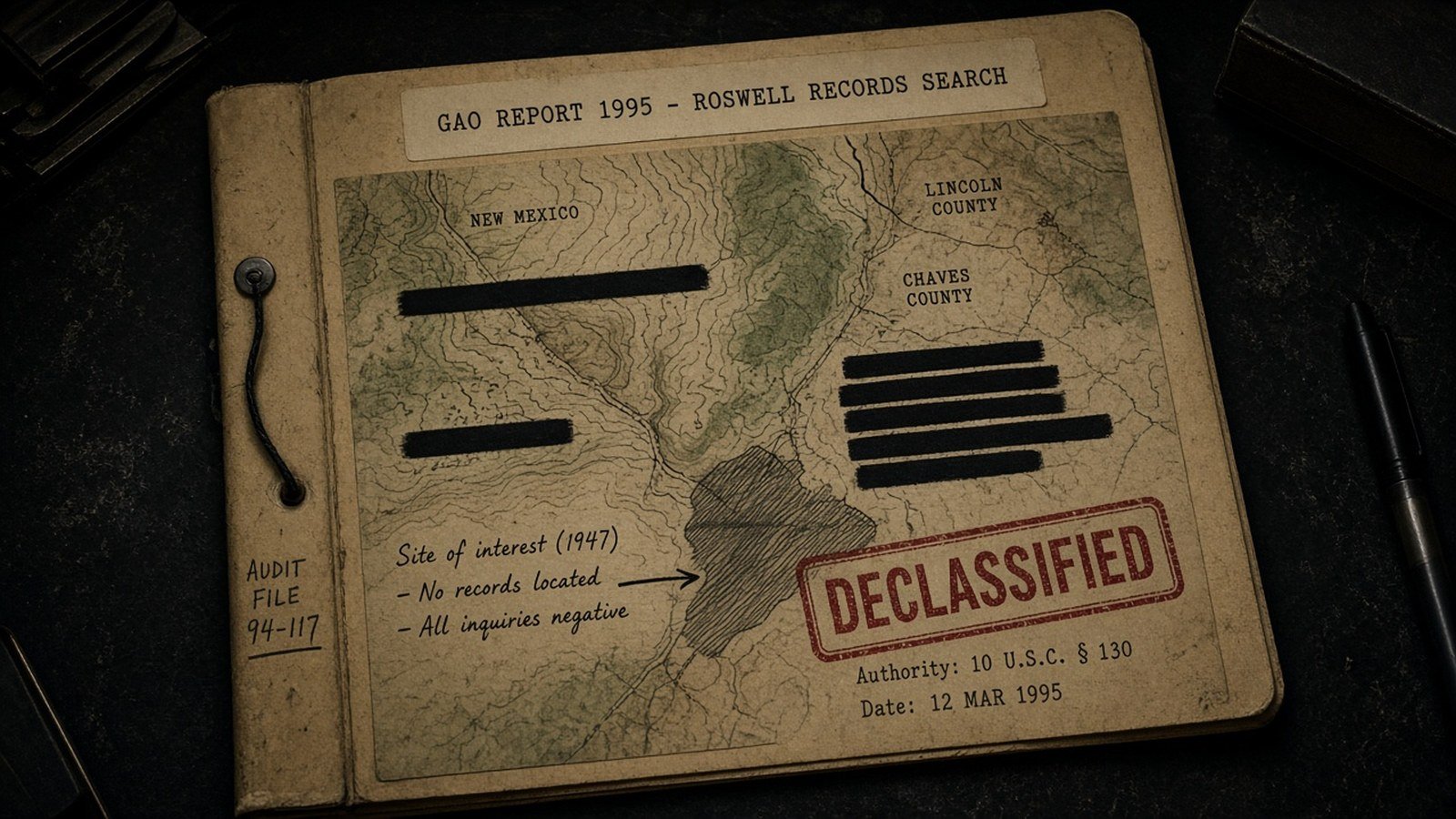
A member of Congress asked the General Accounting Office to find government records about the 1947 Roswell crash. GAO’s 26-page report, GAO/NSIAD-95-187, is dated 28 July 1995.
What it says (quoted)
- It recounts that on 8 July 1947 RAAF announced a “flying disc,” after which the Eighth Air Force in Fort Worth “announced that RAAF personnel had recovered a crashed radar-tracking (weather) balloon, not a ‘flying disc.'”
- It notes that in the July 1994 Air Force report, “the Air Force did not dispute that something happened near Roswell, but reported that the most likely source of the wreckage was from a balloon-launched classified government project designed to determine the state of Soviet nuclear weapons research.”
- “In our search for records concerning the Roswell crash, we learned that some government records covering RAAF activities had been destroyed and others had not.” The destroyed records included RAAF outgoing messages.
CASE FILE · GAO-95-187
Publisher: U.S. General Accounting Office (now Government Accountability Office)
URL: https://www.gao.gov/assets/nsiad-95-187.pdf
Who asked, and why it mattered
The request came from Rep. Steven H. Schiff of New Mexico. The report is addressed to him. He asked GAO, Congress’s independent auditor, to do two things: find out what the rules were in 1947 for reporting air accidents like the one claimed near Roswell, and track down any government records about the crash. In practice, that meant checking whether the paper trail matched the official story.
GAO says it “examined a wide range of classified and unclassified documents dating from July 1947 through the 1950s”. These came from organizations in New Mexico and across the Defense Department, as well as the FBI, the CIA and the National Security Council. It also sent letters of inquiry to executive-branch agencies.
What GAO actually found
1. Air accident reports. Army regulations in 1947 required air accident reports to be kept permanently. GAO found four air accidents reported by the Army Air Forces in New Mexico in July 1947. All involved military aircraft and all happened after 8 July 1947, the day the base announced the “flying disc.” The Navy reported none. Air Force officials told GAO that the rules in force at the time didn’t require any report on a crashed weather balloon.
2. The destroyed records. This finding is the one that fuels the cover-up theory. RAAF administrative records from March 1945 to December 1949 and RAAF outgoing messages from October 1946 to December 1949 had been destroyed. The disposition form “does not indicate what organization or person destroyed the records and when or under what authority.”
GAO then put that in context. The National Personnel Records Center’s chief archivist said that, from his own experience, many Air Force organizational records from that era “were destroyed without entering a citation for the governing disposition authority.” GAO’s review of other destruction forms, including for RAAF outgoing messages from 1950, a year outside the Roswell window, “supports the Chief Archivist’s viewpoint.” In other words, missing paperwork was typical of the era’s record-keeping and not unique to July 1947.
3. Only two 1947 records surfaced. GAO found just two documents from 1947 itself:
– the July 1947 history report of the combined 509th Bomb Group and RAAF, which noted the recovery of a “flying disc” that was “later determined by military officials to be a radar-tracking balloon”; and
– an FBI teletype dated 8 July 1947, from the Dallas office to headquarters and Cincinnati. It said the military had described “a hexagonal-shaped disc suspended from a large balloon by cable,” being sent to Wright Field. The object “resembled a high-altitude weather balloon with a radar reflector,” and the FBI was taking no further action.
4. Silence elsewhere. Records previously withheld on security grounds didn’t mention a Roswell crash. Nor did the Air Force’s Project Blue Book Special Report No. 14 on 1946–1953 sightings.
Why both sides cite it
Believers point to the missing outgoing messages: if anything had been sent to Washington about a crashed craft, those files are where it would have been. Skeptics point out that GAO found no evidence the destruction was targeted, and that the only surviving 1947 records describe a balloon.
On the evidence, the report confirms there’s a gap but gives no evidence for what was in it. That’s why we grade the cover-up claim UNVERIFIED rather than DEBUNKED.
Grades
| Claim | Grade | Source |
|---|---|---|
| GAO searched for Roswell records in 1995 | CONFIRMED | GAO/NSIAD-95-187 |
| Some RAAF records had been destroyed | CONFIRMED | GAO/NSIAD-95-187 |
| The records were destroyed to hide an alien crash | UNVERIFIED | The report does not say this |
| The request came from Rep. Steven Schiff (NM) | CONFIRMED | Report addressee |
| Four AAF air accidents in NM, July 1947, all after 8 July and all military aircraft | CONFIRMED | Results in Brief |
| RAAF outgoing messages Oct 1946–Dec 1949 were destroyed with no authority cited | CONFIRMED | Results in Brief |
| Missing disposition citations were common for Air Force records of the era | CREDIBLE | NPRC Chief Archivist, backed by GAO’s review |
| The FBI’s 8 July 1947 teletype described a disc hung from a balloon, resembling a weather balloon with a radar reflector | CONFIRMED | Report and appendix II |
Log in to view the rest of this file
The rest of this file is open to any agent: free accounts get full access.
Log InCreate a free account