The Wow! Signal: 72 Seconds From Sagittarius (1977)
Subject: Strong narrowband radio signal of unknown origin
Event: Big Ear radio telescope recording, 15 Aug 1977
First report: Spotted on the printout days later by Jerry R. Ehman · Last checked: 4 Nov 2026
Location: Big Ear, Perkins Observatory site, Delaware, Ohio, USA; source in the direction of Sagittarius
Status · Grade: Never detected again; origin UNVERIFIED (margin note: one word, with exclamation point)
ARCHIVE FILE · Event year: 1977. This happened in 1977 and is not breaking news. It’s part of the Redacted Weekly evergreen archive.
What happened
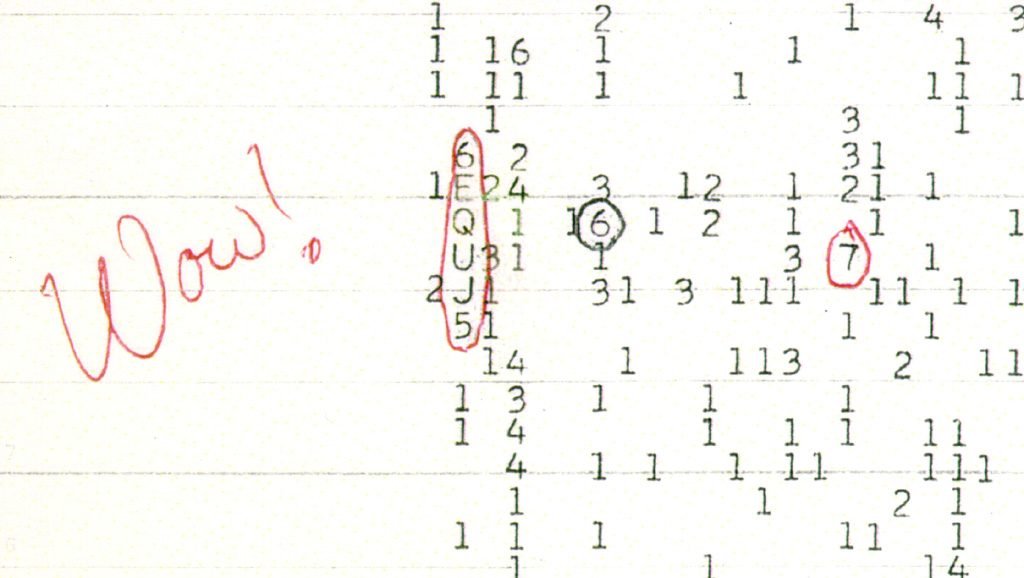
On 15 August 1977, Ohio State University’s Big Ear radio telescope, then used in the search for extraterrestrial intelligence, recorded a strong, narrowband radio signal from the direction of the constellation Sagittarius. It had several hallmarks of what an artificial signal from space might look like. A few days later, astronomer Jerry R. Ehman, reviewing the printouts, circled the reading and wrote one word in the margin: “Wow!”
Ehman told the Cleveland Plain Dealer in 1994, in an article reprinted by the Big Ear observatory: “I mean, without thinking, I wrote ‘Wow!'”
The footage
Video: “The Wow! Signal with Discoverer Dr. Jerry Ehman,” Event Horizon, uploaded 19 December 2019, about 64 minutes. Embedded from the Event Horizon YouTube channel. This is a long-form interview with Ehman, not footage of the 1977 event, which was recorded only as computer printout. The featured image is the public-domain scan of that printout with Ehman’s circled “Wow!”
Timeline
- 1959: Cocconi and Morrison propose listening near 1420 MHz.
- 1963: Big Ear opens at the Perkins Observatory site.
- 1973: Big Ear is assigned to SETI.
- 15 August 1977: The signal is recorded at 22:16 EST (23:16 EDT local; 03:16 UTC on 16 August).
- 1987 and 1989: Robert Gray searches with the META array at Oak Ridge Observatory; no detection.
- 1994: Kraus gives 1420.3556 MHz; Ehman voices doubts.
- 1995: The SETI League tests at Green Bank; Gray uses the Very Large Array (1995–96).
- May 1998: Big Ear’s final pieces are torn down; Ehman gives 1420.4556 MHz.
- 1999: Gray and Simon Ellingsen search from Tasmania.
- 2017: Antonio Paris proposes the comet hypothesis.
- 16 August 2024: Arecibo Wow! I preprint.
- 14 August 2025: Arecibo Wow! II preprint.
What witnesses reported
What “6EQUJ5” means. Big Ear’s printouts recorded signal strength as one character per time step. A space meant near baseline, 1–9 meant increasing intensity, and letters continued from 10 (“A”) upward. The sequence 6EQUJ5 rises to a peak and falls again. The peak, “U,” means 30 to 31 standard deviations above background noise. That’s the profile you’d expect from a fixed point in the sky drifting through the beam of a stationary telescope as Earth turned. The signal lasted the full 72-second window during which Big Ear could observe that spot.
The operator’s job. Ehman was a volunteer who checked output from an IBM 1130 computer by hand, per Wikipedia. Big Ear had no side-to-side steering. It relied on Earth’s rotation to sweep the sky, so any fixed point stayed in its beam for 72 seconds. A steady signal from space should rise for 36 seconds and then fall, and the Wow! signal did exactly that.
What the research found
Why 1420 MHz. In 1959, Cornell physicists Philip Morrison and Giuseppe Cocconi suggested that a civilization trying to make contact by radio might use 1420 MHz, the 21-centimeter line of hydrogen, since any technological species would know it. Bandwidth was under 10 kHz. Big Ear had fifty 10-kHz channels, and the signal showed up in just one.
Log in to view the rest of this file
The rest of this file is open to any agent: free accounts get full access.
Log InCreate a free account